
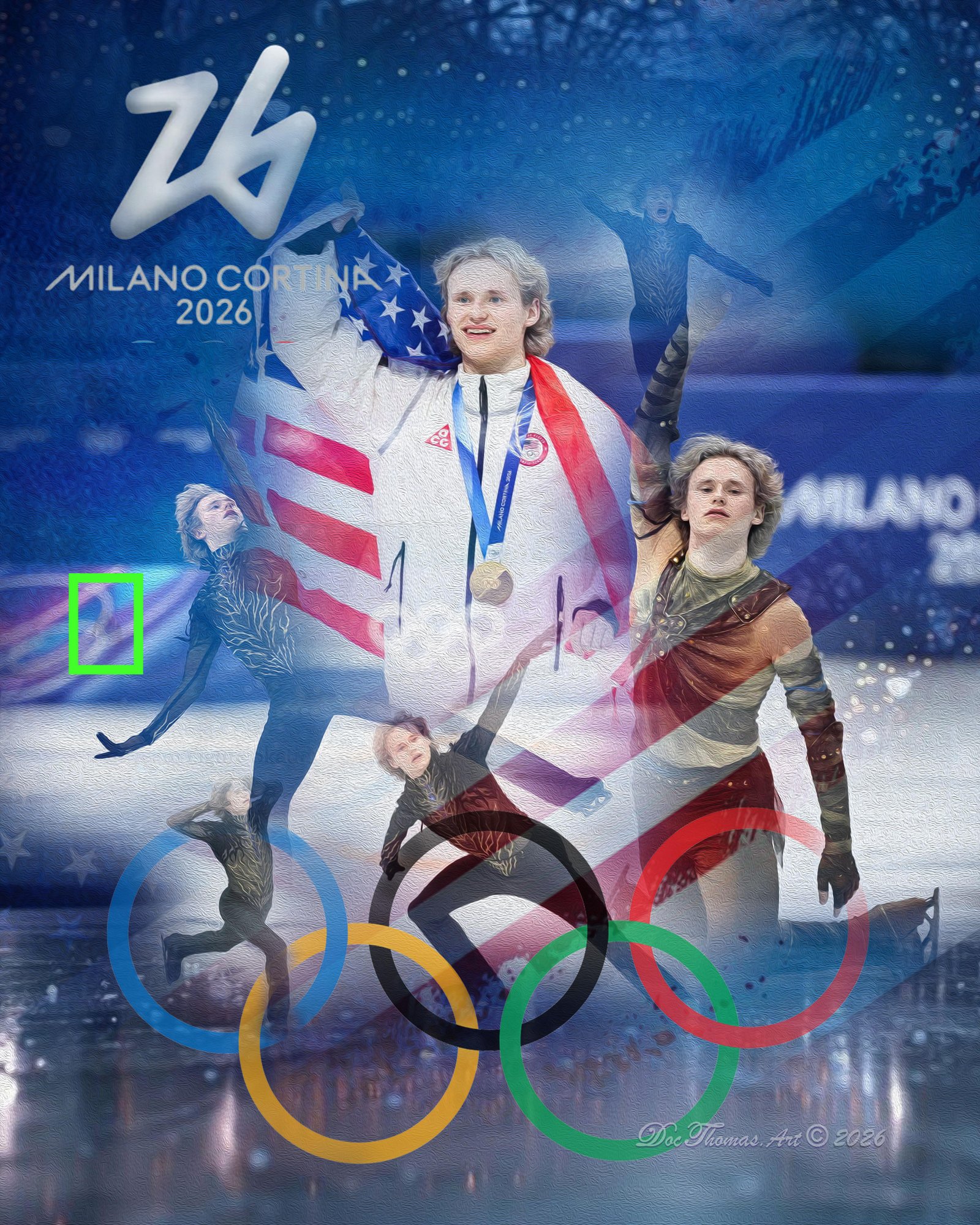

Ultramarine Apex: Malinin and the Vertical Mathematics of Flight
Ultramarine Apex documents Ilia Malinin’s Milano Cortina 2026 Olympic ascent through disciplined chromatic structure and structured numerical continuity. In the Team Event at the Milano Ice Skating Arena, he scored 104.58 (TES 60.14 / PCS 44.44) in the Short Program and 198.76 (TES 113.52 / PCS 85.24) in the Free Skate, earning the maximum 20 placement points toward Team USA’s gold. In the Individual competition, his combined 309.14 total (106.03 SP / 203.11 FS) secured Olympic Gold. Through layered ultramarine fields symbolizing technical precision and softened cobalt gradients representing interpretive fluency, the artwork transforms structured Olympic mathematics into vertical apex — quadruple flight resolved into gold.
Please see Below for Details…


Hotline Order:
Mon - Fri: 07AM - 06PM
404-872-4663
A vertical pillar of ultramarine rises through the canvas like a frozen current of acceleration, and within that column Ilia Malinin ascends — torso aligned, arms extended beneath the American flag, posture governed by discipline rather than spectacle. This composition preserves his Milano Cortina 2026 Olympic arc as structural ascent: compression, propulsion, rotation, resolution. It is not merely an image of triumph; it is the visual equation of quadruple ambition balanced by Olympic calculation.
Ilia Malinin, born December 2, 2004, in Fairfax, Virginia, United States, entered the XXV Olympic Winter Games as the most technically progressive male skater of his era. The son of former elite competitors Tatiana Malinina and Roman Skorniakov, he was raised within the architecture of elite technique. His early development fused biomechanical awareness with rotational experimentation, culminating in his historic ratified quadruple Axel prior to Olympic eligibility. By Milano Cortina 2026, Malinin’s identity was not simply that of a contender — it was that of a technical frontier.
The Olympic Figure Skating Team Event at the Milano Ice Skating Arena (Forum di Milano) structured men’s skating as one of eight cumulative segments. On February 6, 2026, Malinin competed in the Team Event Short Program, delivering a technically controlled performance that registered 104.58, comprised of TES 60.14 and PCS 44.44, with no deductions. The TES reflected quad combinations, leveled spins, and a step sequence executed with positive Grade of Execution values. The PCS captured skating skills, transitions, performance maturity, composition, and interpretation under Olympic scrutiny. His first-place finish secured 10 placement points, establishing immediate structural dominance for Team USA in the men’s discipline.
On February 8, 2026, he returned for the Team Event Free Skate — the longer, technically demanding program where quadruple layout strategy defines competitive hierarchy. His official Free Skate score registered 198.76, composed of TES 113.52 and PCS 85.24, again without deductions. The TES expansion reflected multiple quadruple jumps executed with controlled landing edges and rotational certainty. The PCS growth reflected sustained compositional continuity and performance stamina across the full program. His first-place placement earned an additional 10 placement points, bringing his Team Event contribution to a maximum 20 points — a decisive structural beam within Team USA’s cumulative march to Olympic Team Gold.
Under the Olympic Team Event scoring system, placements determine medal outcome rather than raw totals alone. Points are awarded 10 for first, 9 for second, 8 for third, and so forth. Malinin’s dual segment victories formed the vertical reinforcement of the team architecture. His 104.58 Short Program and 198.76 Free Skate were not decorative statistics; they were load-bearing pillars within the scoring calculus that secured the United States atop the podium.
Four days later, within the same arena, the Individual Men’s competition recalibrated the equation. In the Individual Short Program, Malinin delivered 106.03 (TES 61.87 / PCS 44.16) — maintaining quad integrity under a separate judging configuration. The rotational tightness and landing flow indicated biomechanical refinement rather than excess risk. In the Individual Free Skate, he produced a technically ambitious layout resulting in 203.11 (TES 116.34 / PCS 86.77). The cumulative total reached 309.14, securing Olympic Gold in men’s singles.
In Olympic mathematics, the margin between podium positions often resides within fractional GOE increments and component variance. The total of 309.14 reflects the alignment of base value, execution, and interpretive structure across both segments. The numerical architecture — 106.03 + 203.11 — becomes a visual axis within the painting itself.
Chromatically, Ultramarine Apex emphasizes vertical propulsion over diagonal velocity. Ultramarine dominates because it symbolizes cold atmospheric precision — the environment in which quadruple rotations unfold. The darkest blue planes represent TES: angular, crystalline, objective. Each quad is rendered as a sharp-edged burst of concentrated pigment, signifying base value and execution evaluation. Softer cobalt gradients diffuse outward to represent PCS — interpretive phrasing, musical continuity, and compositional nuance.
Crimson from the American flag flows across the midplane in moderated saturation. It signifies controlled aggression — the explosive knee compression required for quadruple takeoff. The red does not overwhelm; it pulses beneath the ultramarine structure, symbolizing propulsion restrained by regulation. White arcs slice across the frame like blade tracings following landing exit edges. White represents alignment and renewal — the emergence of a new technical era in men’s skating.
Gold illumination appears in two registers. The first is a restrained halo marking the Team Event podium, acknowledging collective triumph. The second is a brighter, concentrated glow around the Individual medal moment — singular apex achieved through rotational architecture. Gold here symbolizes culmination, but it remains proportional, never theatrical.
Visually, the composition layers three exposures: a crouched pre-rotation compression, an airborne quad silhouette suspended mid-axis, and a podium alignment beneath the flag. These phases correspond to scoring structure: base value preparation, GOE execution, cumulative total resolution. The repetition compresses February 6, February 8, and the individual final into a singular continuum — ascent sustained across Olympic days.
Subtle density variations in the upper ultramarine register reflect the razor-thin margins inherent in ISU scoring. Quadruple elements exist at the edge of rotational physics; the painting renders this tension through pigment saturation shifts. The micro-variance acknowledges that even 309.14 is an equation solved within human limits.
From a craft standpoint, light is softened to preserve warmth within institutional structure. Rotational blur appears as feathered pigment along airborne limbs, indicating velocity without chaos. The Olympic rings remain translucent and integrated, reinforcing governance without interrupting compositional equilibrium.
As the artist, I approached Ultramarine Apex as a study in disciplined elevation. Blue dominates because elite men’s skating at Olympic scale is not spectacle alone — it is calculated ascent. Ultramarine represents TES precision; cobalt embodies PCS interpretation. Crimson underlayers convey propulsion within regulation. Gold marks resolution without excess.
Malinin’s biography — Fairfax-born, son of elite skaters, architect of quad Axel innovation — informs the structural lines. The verified structured numbers — 104.58, 198.76, 106.03, 203.11, 309.14 — function as beams within the visual architecture. Mathematics and motion align.
Ultimately, Ultramarine Apex affirms that elevation is not accidental. It is engineered through compression, risk, and alignment. In Milano Cortina 2026, Ilia Malinin transformed rotation into record and calculation into gold. Geometry and gravity negotiated; color and score converged; ultramarine ascended into permanence.
Add your review
Your email address will not be published. Required fields are marked *
Please login to write review!
Looks like there are no reviews yet.

Scarlet Axis: Kam & O’Shea and the Measured Lift of Team Gold
$55,000.00 $55,000.00

Sapphire Continuum: Chock & Bates and the Architecture of Measured Triumph
$54,200.00 $54,200.00
Sapphire Vector: Amber Glenn and the Calculus of Eight Points
$53,500.00 $53,500.00