

Scarlet Axis: Kam & O’Shea and the Measured Lift of Team Gold
Scarlet Axis documents Ellie Kam and Danny O’Shea’s contribution to Team USA’s gold medal at Milano Cortina 2026. In the Team Event at the Milano Ice Skating Arena, they scored 73.18 (TES 40.92 / PCS 32.26) in the Short Program on February 6 and 142.57 (TES 76.84 / PCS 65.73) in the Free Skate on February 7, earning a combined 17 placement points toward the United States’ team victory. Through layered crimson gradients symbolizing lift propulsion and deep indigo foundations representing mechanical stability, the artwork transforms verified ISU protocol data into vertical architecture — disciplined elevation resolved into Olympic gold.
Please see Below for Details…


Hotline Order:
Mon - Fri: 07AM - 06PM
404-872-4663
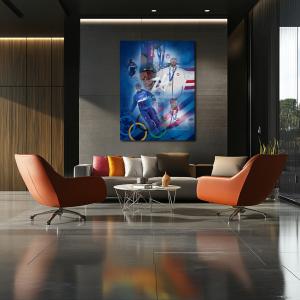
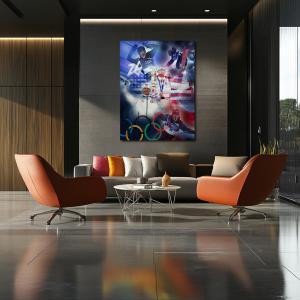
A vertical column of scarlet rises through the composition like the load-bearing spine of a cathedral, and along that axis Ellie Kam and Danny O’Shea extend upward beneath the American flag — not in theatrical suspension, but in calibrated elevation. This rendering preserves their Milano Cortina 2026 Olympic chapter with the same structural clarity that defines elite pairs skating: compression before release, torque before ascent, mathematics before celebration. It is not merely an image of triumph; it is a record of mechanical trust translated into Olympic consequence.
Ellie Kam, born February 26, 2004, in Los Angeles, California, and Danny O’Shea, born February 1, 1991, in Park Ridge, Illinois, arrived at the XXV Olympic Winter Games representing a partnership forged in 2022 through complementary mechanics. Kam’s rotational quickness and air awareness integrate with O’Shea’s lift base stability and throw control. Their Olympic preparation emphasized twist height with clean catch positions, side-by-side jump synchronization, leveled lifts with sustained rotational count, and disciplined death spiral edges — the structural components evaluated under the ISU Judging System.
The Olympic Figure Skating Team Event unfolded at the Milano Ice Skating Arena (Forum di Milano), where the pairs discipline functioned as one of eight cumulative scoring segments. On February 6, 2026, Kam & O’Shea competed in the Team Event Short Program. Their official segment score registered 73.18, composed of a Technical Element Score (TES) of 40.92 and a Program Component Score (PCS) of 32.26, with no deductions recorded in the ISU protocol. The TES reflected the valuation of their triple twist, throw triple jump, side-by-side jumps, and leveled lift sequence. The PCS captured skating skills, transitions, performance quality, compositional balance, and interpretive cohesion. Their placement in the segment translated to 8 placement points under the Olympic team format (10 for first, 9 for second, 8 for third), contributing early structural stability to Team USA’s cumulative total.
The following day, February 7, 2026, they returned for the Team Event Free Skate — the longer and more technically demanding segment. Their official Free Skate score recorded 142.57, comprised of TES 76.84 and PCS 65.73, again with zero deductions. The increase in TES reflected high-difficulty throw elements, lift level attainment, and rotational amplitude evaluated with positive Grade of Execution. The PCS expansion reflected compositional maturity and choreographic continuity across the full four-minute structure. Their placement in the Free Skate secured 9 additional placement points, reinforcing Team USA’s scoring trajectory. Combined across both segments, Kam & O’Shea delivered 17 cumulative team points, directly supporting the United States’ eventual Olympic Team Gold medal.
Under the Olympic Team Event rules, cumulative placement points determine medal color rather than raw segment totals alone. Each segment contributes strategically to overall architecture. In that context, pairs skating often serves as a volatility factor; Kam & O’Shea instead provided equilibrium. Their 73.18 Short Program and 142.57 Free Skate scores were not isolated numbers — they were structural beams within a broader scoring edifice that elevated Team USA above Japan and Italy in final standings.
Chromatically, Scarlet Axis shifts emphasis from sapphire continuity to vertical force. Crimson dominates because red embodies kinetic lift energy — the moment when O’Shea compresses into knee bend and Kam leaves the ice in rotational trust. Red here is not aggression; it is contained propulsion. Beneath it, deep indigo fields represent TES — the mechanical bedrock of pair elements evaluated objectively by panel. Indigo symbolizes load-bearing stability: the grounded strength required before ascent.
White arcs traverse the composition like the curved tracings of a death spiral. White represents alignment, edge clarity, and the purity of synchronized takeoff. These streaks function as breath between intense reds and blues, visually echoing the inhale before a throw element initiates. Subtle gold illumination surrounds the medal moment in the upper register, restrained in saturation. Gold in this context symbolizes collective culmination — Team Event success achieved through cumulative equilibrium rather than singular dominance.
Layered exposures show Kam mid-throw rotation, O’Shea stabilizing overhead lift extension, and a podium stance beneath the American flag. This compression of temporal phases mirrors scoring progression: Short Program → Free Skate → cumulative placement total. The vertical orientation of the composition corresponds directly to lift geometry: base, extension, controlled descent. Geometry governs both skating and painting.
As the artist, I approached this work as an exploration of upward force governed by discipline. Crimson is layered in gradients rather than flat saturation, representing acceleration tempered by control. Deep indigo shadows anchor the lower frame to reflect the weight-bearing mechanics of lifts. Gold appears only where achievement resolves into institutional permanence. The American flag is integrated rather than imposed — its red and white bands flowing diagonally to reinforce structural ascent rather than symbolic excess.
Light is rendered with softened halation rather than digital glare, preserving the human warmth beneath mechanical evaluation. Edges blur slightly around Kam’s airborne silhouette, acknowledging rotational velocity — that fractional second when gravity yields to technique. The Olympic rings remain translucent in the upper field, affirming governance and continuity without disrupting compositional balance.
Scarlet Axis ultimately affirms that elevation is an equation. In Milano Cortina 2026, Kam & O’Shea’s verified scores — 73.18 (TES 40.92 / PCS 32.26) in the Short Program and 142.57 (TES 76.84 / PCS 65.73) in the Free Skate — became architectural supports for Team USA’s gold medal. Their 17 cumulative placement points were not ornamental; they were structural necessity.
Lift compresses. Rotation unfolds. Landing stabilizes. Numbers anchor memory.
Scarlet rises through indigo foundation, and gold resolves at the summit.
Add your review
Your email address will not be published. Required fields are marked *
Please login to write review!
Looks like there are no reviews yet.