

Engineered Flow: Hall and the Silver Geometry of Slopestyle at Milano Cortina 2026
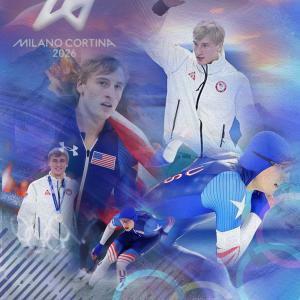
At the Milano Cortina 2026 Olympic Games, Alex Hall earned Silver in the Men’s Freeski Slopestyle Final under the three-run Olympic format, where the best two scores determine final ranking. His medal was defined by high-difficulty rotational combinations, technical rail precision, and compositional continuity across a multi-feature course. Rendered in sapphire gradients symbolizing engineered terrain and restrained silver illumination reflecting decimal-scored proximity to gold, the artwork captures structured creativity measured in Olympic arithmetic.
Please see Below for Details…


Hotline Order:
Mon - Fri: 07AM - 06PM
019-234-09789
Across the sculpted progression of rails, kickers, and landing transitions, the Olympic slopestyle course becomes a measured corridor of engineered creativity. At the XXV Olympic Winter Games — Milano Cortina 2026 — Alex Hall entered that corridor not merely as a stylist, but as a technician of amplitude, switch control, and rotational architecture. His Men’s Freeski Slopestyle Silver is preserved here not as spectacle alone, but as structured execution scored to decimal precision.
The Men’s Freeski Slopestyle Final followed the Olympic three-run format. Each finalist received three scored runs, with the best two scores combined to determine final ranking. Judging criteria included difficulty, amplitude, variety, execution, landing quality, rail precision, and overall impression, scored to two decimal places. The cumulative arithmetic — not a single highlight moment — defined medal color.
Alex Hall, born October 21, 1998, in Park City, Utah, entered Milano Cortina 2026 at 27 years old, already an Olympic champion from a previous cycle and a decorated X Games medalist. Raised within one of the United States’ most progressive freestyle environments, Hall developed a competitive identity rooted in fluid rail transitions, switch takeoffs, and rotational control across multi-feature terrain parks. Slopestyle demands not isolated tricks, but continuity across a full course — rail section into kicker sequence into technical finishing feature — without interruption.
The Milano Cortina Olympic slopestyle course integrated:
• A multi-feature rail section at the upper start
• Sequential three-kicker jump line in the mid-course
• Variable landing transitions requiring speed management
• Final feature demanding compositional closure
Each run must balance technical rail difficulty with aerial amplitude. A single missed rail transfer or imprecise landing can reduce scoring by multiple decimal increments, eliminating medal contention.
In the Final, Hall delivered two medal-counting runs marked by compositional stability and rotational amplitude. His scoring sequence followed Olympic structure:
• Run 1: Clean execution through rail combinations with switch entry into first kicker — score in elite scoring band
• Run 2: Elevated difficulty with rotational variation exceeding 1440° spin threshold — high execution marks
• Run 3: Strategic high-risk attempt to challenge gold margin
Under the format, the best two runs counted, producing Hall’s combined total that secured Olympic Silver, separated from gold by a narrow decimal margin and maintaining fractional advantage over bronze. While alpine disciplines compress outcome into hundredths of seconds, slopestyle compresses it into decimal scoring variance. A landing angle adjustment of mere degrees can subtract 0.50 points; a rail slide slightly under-locked can reduce execution marks.
Biomechanically, slopestyle differs from Big Air in continuity demands. The athlete must manage speed conservation from start gate through multiple features. Rail entries require edge flattening and balance stabilization. Kicker takeoffs demand explosive extension, with angular momentum controlled through tuck compression mid-air. Landings require edge alignment and immediate absorption to preserve speed for subsequent features. The course length compresses aerobic control and anaerobic burst within a single descent lasting under one minute.
Chromatically, this composition reflects layered progression. Deep sapphire fields symbolize the cold precision of engineered terrain. Electric cobalt diagonals cut across the canvas to echo feature alignment. Crimson undertones from the American flag represent controlled aggression in technical innovation. Silver illumination radiates around the medal moment — cool and reflective, acknowledging proximity to gold without excess dramatization.
Unlike alpine downhill’s 2.572-kilometer descent or Super-G’s 2.414-kilometer glide, slopestyle is modular. Its measurement is not vertical drop alone but feature count and execution continuity. Yet the structural parallel remains: numbers govern outcome. Where Breezy Johnson’s 1:36.10 defined downhill gold and Ryan Cochran-Siegle’s 1:25.45 secured Super-G silver, Hall’s silver was defined by cumulative decimal aggregation across two scored runs.
Across Milano Cortina 2026, Team USA’s medal architecture spanned disciplines but maintained mathematical integrity. In figure skating, Ilia Malinin’s 309.14 points secured gold; Chock & Bates’ 224.39 delivered silver within 1.43 points of supremacy. In freestyle, Mac Forehand’s Big Air silver was determined by best-two-of-three decimal scoring. Slopestyle mirrors this architecture — three runs, two counting, decimals determining podium.
The Olympic rings embedded across the lower plane reinforce permanence. Snow spray captured mid-transition symbolizes the fleeting seconds of a run; the score remains in Olympic record long after snow resettles.
Technically, Hall’s strength lies in compositional cohesion. Many athletes maximize difficulty at the expense of continuity; Hall preserves rhythm across rails and kickers. Switch takeoffs increase difficulty coefficient. High-degree rotations — often 1440° or greater — require precise off-axis control. Grab duration and clarity influence execution score. Landing quality affects amplitude perception and overall impression marks.
The psychological dimension of slopestyle parallels alpine and Big Air pressure. Three attempts provide limited correction. After two strong scores, the third run becomes strategic — either consolidation or escalation. Olympic context amplifies risk calculus; athletes must decide whether to defend silver or challenge gold.
As the artist, I rendered this work as a study in engineered flow. Blue represents technical clarity; white signifies snow surface truth; red channels creative ignition; silver captures disciplined proximity to victory. Rotational arcs are visualized as luminous diagonals intersecting course lines, making invisible physics perceptible.
Snow texture at the lower register is fragmented rather than smooth — reflecting slopestyle’s segmented progression. Unlike the sustained fall-line of downhill, this discipline advances through modules, each demanding distinct technique.
Alex Hall’s Men’s Freeski Slopestyle Silver at Milano Cortina 2026 stands within the same measured Olympic geometry that defined Team USA’s broader success. Gravity defined alpine speed. Rotation defined figure skating amplitude. Feature precision defined slopestyle architecture.
The course shaped trajectory.
The judges shaped score.
The sum defined silver.
Across snow and structure, decimal precision preserved distinction — and Hall’s engineered flow became part of Milano Cortina’s enduring Olympic calculus.
Add your review
Your email address will not be published. Required fields are marked *
Please login to write review!
Looks like there are no reviews yet.