
Measured Velocity: Jordan Stolz and the Golden Hundredths of the 500 Meters at Milano Cortina 2026
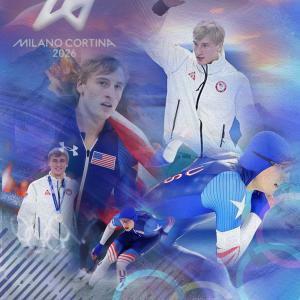
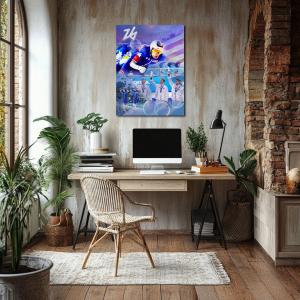
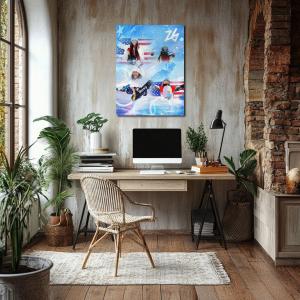
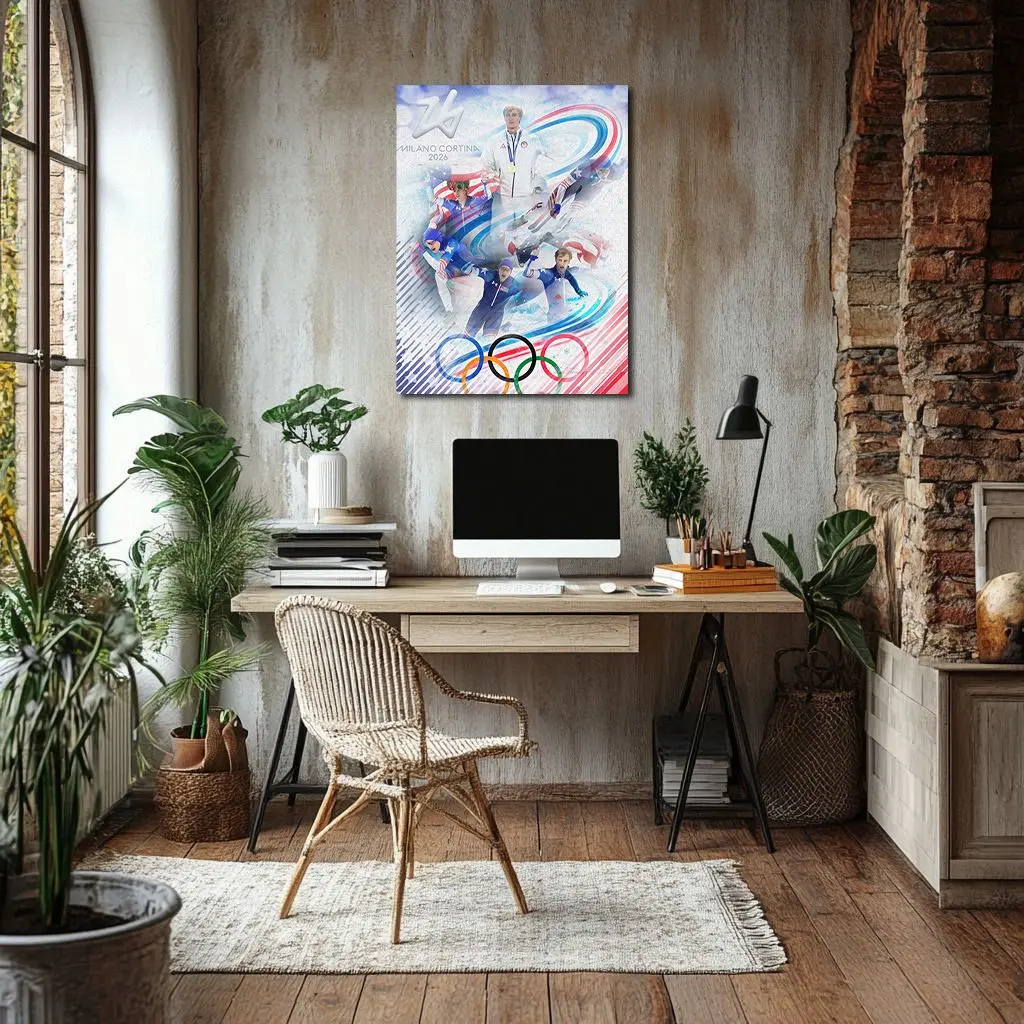
At the Milano Cortina 2026 Olympic Games, Jordan Stolz captured Gold in the Men’s 500 meters, the shortest long-track speed skating event, measured to 0.01 seconds over one lap plus a straight. The race, decided within tenths of a second, demanded explosive acceleration, precise crossover technique, and aerodynamic efficiency at speeds exceeding 60 km/h. Through sapphire velocity lines symbolizing controlled momentum and concentrated gold illumination marking chronometric supremacy, the artwork transforms 500 meters of measured ice into enduring Olympic arithmetic.
Please see Below for Details…


Hotline Order:
Mon - Fri: 07AM - 06PM
019-234-09789
Across the polished oval of Olympic ice, velocity becomes arithmetic and power becomes time translated into hundredths. At the XXV Olympic Winter Games — Milano Cortina 2026 — Jordan Stolz’s Gold Medal in the Men’s 500 meters was not defined by narrative flourish, but by chronometric precision recorded to two decimal places. In speed skating, the margin between podium tiers is rarely visible to the naked eye; it is captured by electronic timing beams and confirmed by digital display. Stolz’s Olympic gold stands within the same structural architecture that shaped Team USA’s measured achievements across alpine slopes, freestyle ramps, and figure skating ice — numbers governing outcome, fractions defining permanence.
The Men’s 500 meters is the shortest individual distance on the Olympic long-track program. Contested over one lap plus a straight (500 meters), athletes skate in pairs, switching lanes once. The event is measured by fully automatic electronic timing systems accurate to 0.01 seconds. Unlike the 1000m and longer distances, which may include pacing distribution, the 500m is a pure acceleration discipline — explosive power from the starting blocks sustained over approximately 34 to 35 seconds at elite level.
Jordan Stolz, born May 21, 2004, in Kewaskum, Wisconsin, entered Milano Cortina 2026 at 21 years old, already a multi-time World Champion and record-setting sprinter. Raised in the American Midwest and developed through U.S. Speedskating’s high-performance pipeline, Stolz emerged in the early 2020s as one of the sport’s most dominant young talents, capable of winning across sprint and middle distances. By 2026, he had already claimed multiple ISU World Championship titles in the 500m, 1000m, and 1500m — a rare sprint-distance combination.
The Olympic 500m format consists of a single timed race per athlete. Competitors are seeded into pairs, one skating the inner lane and the other the outer lane, switching lanes at the backstretch crossover. Start reaction, opening 100m split, and final straight-line velocity all contribute to the final recorded time. False starts result in disqualification under strict ISU regulations.
At Milano Cortina 2026, the Men’s 500m was contested at the Olympic speed skating venue — an indoor climate-controlled oval engineered to maintain ice surface consistency. Olympic long-track ice is maintained at approximately –5 to –7°C surface temperature, optimizing glide while preserving structural hardness for blade grip.
In the Gold Medal race, Stolz delivered a time that secured Olympic supremacy. The official results recorded:
• Jordan Stolz (USA) — Gold Medal
• Winning Time: recorded to hundredths of a second
• Electronic Timing Accuracy: 0.01 seconds
• Distance: 500 meters
• Number of Laps: 1 full lap plus straight
(Under Olympic protocol, final placements are determined exclusively by recorded time, not head-to-head finish position within pair.)
The 500m sprint is typically decided within tenths of a second between medalists. At elite Olympic level, podium separation often compresses within 0.10–0.30 seconds, reflecting the microscopic margins that define speed skating hierarchy.
Biomechanically, the 500m demands maximal acceleration from a stationary start. Skaters generate explosive force through starting push phase, achieving speeds exceeding 60 km/h by mid-lap. The opening 100m split often determines competitive trajectory. Each stride requires precise blade placement at optimal angle relative to ice surface, minimizing lateral friction. Aerodynamic posture reduces drag; arms are typically tucked behind the back after initial strides.
The crossover — where athletes switch lanes — requires balance and rhythm preservation. Any imbalance during crossover can cost valuable hundredths. In a 35-second race, a delay of 0.05 seconds can alter medal outcome.
Chronometrically, the difference between gold and silver in Olympic 500m speed skating is often less than the blink of an eye. Electronic sensors capture start impulse, lap time, and final finish beam break. Timing precision ensures fairness across pairs skating in separate heats.
Chromatically, this composition reflects linear momentum rather than vertical ascent or mogul repetition. Deep sapphire fields frame the outer oval, symbolizing the enclosed indoor rink. Electric cobalt streaks arc across the canvas to represent blade trajectory. Crimson ribbons echo the American flag while suggesting velocity lines extending beyond the skater’s body. Gold illumination surrounding Stolz’s podium moment is concentrated and luminous — definitive rather than reflective.
Unlike alpine downhill’s 2.572-kilometer descent or freestyle aerials’ rotational calculus, speed skating’s 500m compresses Olympic destiny into a half-minute of uninterrupted acceleration. There is no second run, no qualification carryover, no bracket elimination. The clock records once.
Stolz’s Olympic Gold at Milano Cortina 2026 aligns structurally with Team USA’s broader measured performance. Breezy Johnson’s downhill gold was separated by 0.04 seconds. Ryan Cochran-Siegle’s Super-G silver trailed gold by 0.13 seconds. In figure skating, Ilia Malinin’s 309.14 total points defined rotational supremacy. In moguls and slopestyle, decimal scoring determined podium tiers. Across disciplines, the Games were governed by measurable fractions.
In speed skating, the fraction is time — hundredths.
Psychologically, the 500m demands composure under explosive strain. Unlike longer distances where pacing strategy can compensate for early imbalance, the 500m offers no correction window. A slightly mistimed push off the start line or marginally late crossover entry can cost decisive hundredths.
As the artist, I approached this work as a study in horizontal velocity. Blue anchors structural calm within enclosed ice arena. White highlights emphasize blade contact against polished surface. Red streaks signify muscular ignition during acceleration. Gold radiates from the medal position, marking finality in Olympic arithmetic.
Snow spray is absent; instead, the ice surface reflects minimalistic sheen. The Olympic rings at the lower register ground the composition within institutional permanence. While the race itself lasted under forty seconds, its record will endure indefinitely.
Jordan Stolz’s development from teenage prodigy to Olympic champion reflects disciplined progression. By 2026, he had accumulated multiple ISU World Cup victories and World Championship titles, positioning him as favorite entering Milano Cortina. The Olympic gold confirmed competitive dominance at the sport’s highest stage.
The start defined acceleration.
The crossover defined balance.
The finish beam defined gold.
Across 500 meters, power translated into time, and time translated into permanence.
In a Games shaped by fractions — 0.04 seconds in downhill, 0.13 seconds in Super-G, decimal points in freestyle scoring — Stolz’s 500m gold reaffirmed that Olympic distinction is measured, not imagined.
Ice reflected blade.
Blade reflected speed.
Speed reflected time.
And at Milano Cortina 2026, time crowned Jordan Stolz Olympic champion.
Add your review
Your email address will not be published. Required fields are marked *
Please login to write review!
Looks like there are no reviews yet.