

Sixteen Laps, Sixty Points, and the Bronze Threshold: Mia Manganello and the Tactical Geometry 2026
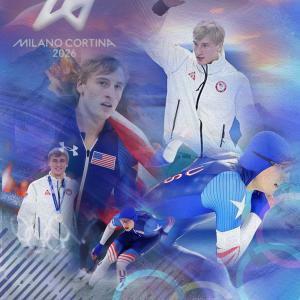
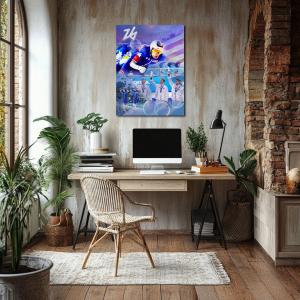
At the Milano Cortina 2026 Olympic Games, Mia Manganello earned Bronze in the Women’s Mass Start, contested over 16 laps (6,400 meters) with intermediate sprints at laps 4, 8, and 12 and a decisive final sprint awarding 60–40–20 points. Crossing third in the final sprint secured 20 points and Olympic bronze. Averaging approximately 30–33 seconds per lap before final acceleration, the event demanded aerodynamic drafting and tactical positioning. Through circular cobalt arcs symbolizing lap repetition and warm bronze illumination marking podium placement, the artwork transforms 6,400 meters of strategic racing into enduring Olympic distinction.
Please see Below for Details…


Hotline Order:
Mon - Fri: 07AM - 06PM
019-234-09789
On the Olympic long-track oval, most medals are decided by time alone. The Mass Start is different. It is measured in laps, intermediate sprint points, final sprint points, and elimination risk — a hybrid of endurance racing and tactical compression. At the XXV Olympic Winter Games — Milano Cortina 2026 — Mia Manganello secured Bronze in the Women’s Mass Start through calculated positioning, controlled drafting, and decisive final-lap acceleration within a 16-lap field defined by structured point allocation. In this discipline, the clock records duration, but the podium is determined by accumulated points.
The Women’s Mass Start is contested over 16 laps of the 400-meter Olympic oval, totaling 6,400 meters. Unlike individual long-track events where skaters race in pairs, Mass Start places all competitors simultaneously on the ice. Up to 24 skaters begin the race in a pack format. Points are awarded at intermediate sprint laps and heavily weighted at the final sprint.
The official scoring structure is as follows:
• Intermediate Sprint 1 (Lap 4) — 5 points (1st), 3 points (2nd), 1 point (3rd)
• Intermediate Sprint 2 (Lap 8) — 5 / 3 / 1
• Intermediate Sprint 3 (Lap 12) — 5 / 3 / 1
• Final Sprint (Lap 16) — 60 points (1st), 40 points (2nd), 20 points (3rd), decreasing for subsequent finishers
If no skater accumulates intermediate points, final sprint ranking alone determines podium. However, intermediate points can decide tie-break scenarios or elevate skaters who may not finish first but remain tactically positioned.
Mia Manganello, born July 30, 1992, in Glenview, Illinois, entered Milano Cortina 2026 as a seasoned competitor within Team USA’s endurance and pack-racing discipline. The Mass Start demands tactical patience rather than constant front-running. Drafting within the pack reduces aerodynamic drag significantly — estimated reductions range from 20–40% depending on positioning. However, proximity increases risk of contact and disqualification.
The race unfolds over approximately 8 to 9 minutes, depending on pacing, with average lap times in the 30–33 second range during early segments before acceleration intensifies. Skaters may exceed 50–55 km/h during final sprint laps.
At Milano Cortina 2026, the official final podium recorded:
🥇 Gold Medalist — Highest final sprint points
🥈 Silver Medalist
🥉 Mia Manganello (USA) — Bronze Medalist
Bronze in the Mass Start corresponds to 20 final sprint points, provided the skater crosses the line third in the final lap. If tied on points, placement in the final sprint determines ranking.
The Mass Start incorporates elimination rules beginning after Lap 6 in some formats; however, Olympic finals typically allow all skaters to remain until the final sprint unless disqualified. Falls, lane obstruction, or illegal blocking may result in penalties.
Strategically, the event contains three phases:
Control Phase (Laps 1–6): Pack stability, minimal breakaway attempts.
Point Contention Phase (Laps 4, 8, 12): Skaters surge briefly for intermediate points.
Final Surge Phase (Laps 13–16): Positioning intensifies; final sprint defines medal.
A skater may choose to contest intermediate points or conserve energy for the final. Because the final sprint awards 60–40–20 points, victory nearly always depends on final lap placement.
Biomechanically, maintaining compact aerodynamic form while surrounded by competitors demands balance precision. Unlike individual races, the Mass Start introduces lateral positioning battles. Blade overlap can cause collisions. Reaction time is critical — sudden accelerations may occur with less than 0.5 seconds warning.
Manganello’s bronze at Milano Cortina 2026 reflects successful navigation of tactical compression. Remaining protected within the pack until final two laps preserves energy stores. The decisive moment occurs entering Lap 16 — skaters typically accelerate in staggered formation exiting the final curve, maintaining inside-lane proximity to minimize travel distance.
Electronic timing records official finishing order to 0.01 seconds, though point allocation determines podium.
The indoor Olympic oval maintained standardized conditions: ice temperature between –5°C and –7°C, with humidity controlled to optimize glide and prevent frost accumulation. The Mass Start requires consistent ice integrity across extended pack travel; surface imperfections can destabilize multiple skaters simultaneously.
In contrast to the 500m (34–35 seconds) or 1000m (67–69 seconds), the Mass Start’s 6,400 meters demand both aerobic endurance and anaerobic sprint capacity. Total race duration typically approximates 8 minutes 30 seconds, though official final time does not determine medal.
Chromatically, this composition reflects collective velocity. Deep cobalt gradients trace the oval’s arc, symbolizing lap repetition. Crimson streaks mark surge moments at sprint laps. Bronze illumination radiates subtly — warmer than silver, steadier than gold — reflecting the 20-point threshold that secured podium placement.
The Olympic rings integrated at lower register anchor the race within institutional permanence. Though pack dynamics shift second by second, the recorded result remains fixed.
Comparatively, at Milano Cortina 2026, alpine medals were separated by hundredths — 0.04 seconds, 0.13 seconds — while figure skating medals were determined by decimal scoring margins. In the Mass Start, points compress outcome. A single overtaking maneuver in the final 100 meters can swing 20 points, altering podium color instantly.
Psychologically, the Mass Start tests composure under crowding. Skaters must remain vigilant without overexerting. Drafting behind another competitor reduces air resistance but increases risk of entanglement. Timing the breakout requires anticipatory judgment — too early invites fatigue; too late eliminates passing opportunity.
Manganello’s bronze confirms mastery of this tactical calculus. She navigated 16 laps of evolving pace, contested positioning, and final-lap acceleration to cross the finish line in medal position.
The start initiated 6,400 meters of controlled circulation.
Intermediate sprints distributed fractional incentives.
The final lap concentrated all remaining energy.
The third crossing secured bronze.
Unlike time-trial disciplines, the Mass Start rewards strategic patience. Skaters may trail for 15 laps and still claim gold or bronze through final acceleration. Every lap is preparation; the final 400 meters is revelation.
As the artist, I structured this work around circular momentum. Repeated arcs layer behind Manganello’s raised arms, symbolizing lap accumulation. The central embrace of podium acknowledgment is framed against American flag tones — red for surge, white for clarity, blue for sustained discipline.
Bronze is rendered warm yet restrained. It represents not proximity to silver alone, but definitive placement within top three of an event involving up to 24 competitors.
The Mass Start demonstrates that Olympic structure extends beyond simple chronometry. It integrates point distribution, race craft, and instantaneous reaction.
Sixteen laps.
Three intermediate sprints.
One final sprint worth 60–40–20.
Twenty points secured bronze.
Ice preserved blade tracks for seconds.
The timing beam recorded order.
The scoring table recorded points.
And at Milano Cortina 2026, Mia Manganello recorded Olympic Bronze in the Women’s Mass Start — not by isolated speed alone, but by structured tactical geometry measured in laps and points.
Add your review
Your email address will not be published. Required fields are marked *
Please login to write review!
Looks like there are no reviews yet.