

Calibrated Collision: Jaelin Kauf and the Silver Margins of Dual Moguls at Milano Cortina 2026
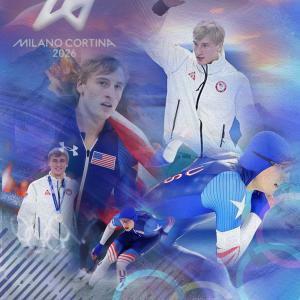
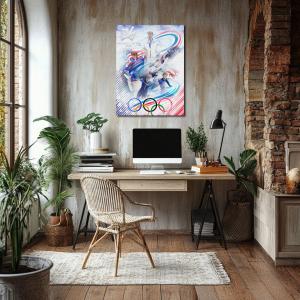
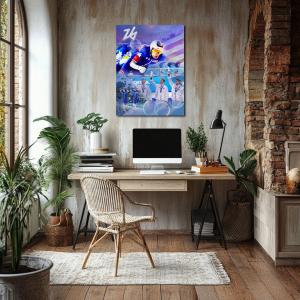
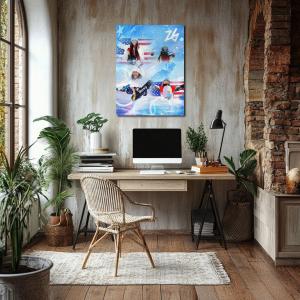
At the Milano Cortina 2026 Olympic Games, Jaelin Kauf earned Silver in Women’s Dual Moguls through a head-to-head elimination format judged across Turns (50%), Air (25%), and Speed (25%). Competing on a steep mogul course exceeding 200 meters of vertical drop and more than 50 bumps per run, Kauf advanced through bracket rounds before securing Olympic Silver in the Gold Medal Final. Through icy blue textures symbolizing rhythmic absorption and restrained silver illumination reflecting categorical precision, the artwork transforms repetitive impact and aerial control into enduring Olympic architecture.
Please see Below for Details…


Hotline Order:
Mon - Fri: 07AM - 06PM
019-234-09789
Across the steep, zipper-lined face of the Olympic moguls course, rhythm becomes impact and timing becomes arithmetic. At the XXV Olympic Winter Games — Milano Cortina 2026 — Jaelin Kauf’s Women’s Dual Moguls Silver was not defined by abstraction or spectacle alone, but by measurable structure: head-to-head brackets, judge-derived scoring categories, and cumulative precision across absorption, aerial execution, and velocity. This composition preserves that performance within the same disciplined Olympic framework that shaped Team USA’s alpine and freestyle architecture throughout the Games.
The Women’s Dual Moguls event was contested on a purpose-built mogul course constructed to international FIS specifications. Moguls courses typically feature a vertical drop between 200 and 270 meters, with a pitch gradient averaging 26 to 28 degrees, and a mogul count often exceeding 45–55 bumps between start and finish. Two athletes descend simultaneously on parallel lanes. Unlike single moguls qualification — where athletes perform individually and are scored against objective criteria — Dual Moguls advances through elimination rounds in direct head-to-head format. Advancement is determined by majority judge decision, based on comparative scoring across three weighted categories: Turns (50%), Air (25%), and Speed (25%).
Jaelin Kauf, born September 26, 1996, in Alta, Wyoming, entered Milano Cortina 2026 at 29 years old, carrying World Cup titles and Olympic experience into her second Olympic cycle. Raised in the Tetons and developed through the U.S. Ski Team freestyle program, Kauf’s competitive identity has long been anchored in absorption discipline — rapid knee articulation absorbing mogul impact while preserving forward momentum.
Dual Moguls competition begins with qualification seeding. Athletes are ranked based on prior single moguls qualification scores, which determine bracket placement. The elimination bracket progresses through:
• Round of 16
• Quarterfinals
• Semifinals
• Small Final (bronze match)
• Big Final (gold/silver match)
Each head-to-head run is evaluated by a panel of judges who assign comparative points per category. A typical Olympic dual moguls judging system includes five judges for turns, two judges for air, and electronic timing for speed comparison. The athlete with majority category wins advances.
Throughout Milano Cortina 2026, Kauf advanced methodically through bracket rounds, demonstrating consistent turn execution across densely spaced moguls and clean aerial form off the two designated jumps placed mid-course. Moguls aerial elements often include back layouts, corked 720° rotations, or inverted combinations, scored on amplitude, difficulty, and landing precision.
In her semifinal, Kauf secured advancement by superior turn quality — absorbing moguls with minimal upper-body deviation and maintaining fall-line continuity. Turn score dominance is decisive in dual format, given its 50% weighting. Speed, while significant, cannot compensate for compromised turn control. Air execution — comprising two jumps — must balance difficulty and clean landing to avoid point deduction.
The Gold Medal Final positioned Kauf head-to-head against the eventual Olympic champion. Under Olympic protocol, both athletes completed the course in parallel lanes over approximately 20 to 23 seconds of descent time, depending on course length and snow condition. Judges evaluated comparative performance in real time. Kauf’s final run secured Silver after majority judge decision favored her opponent in combined category assessment.
Unlike alpine events measured to hundredths of a second — such as 1:36.10 in downhill or 1:25.45 in Super-G — dual moguls medals are determined through majority scoring judgment across weighted criteria. Yet the precision remains exact. A slightly wider turn entry, marginally delayed absorption, or softer landing compression can shift category outcome.
The course surface was prepared to hard-packed mogul consistency under winter alpine conditions. Snow texture directly influences absorption rhythm; ruts can destabilize edge set if upper-body discipline falters. Kauf’s technique reflects refined ankle flexion, knee compression cycles, and forward torso alignment to maintain rhythm across more than 50 moguls per descent.
Biomechanically, moguls skiing requires rapid flexion-extension cycles often exceeding 2–3 absorptions per second, sustained across 200+ vertical meters. The athlete’s center of mass must remain forward while knees articulate independently. Air phases, though brief, require full-body stabilization mid-rotation before re-engaging the mogul field.
Chromatically, this composition shifts from alpine’s elongated diagonals to rhythmic vertical segmentation. Ice-blue gradients dominate the upper register, symbolizing mogul crest lines under alpine sky. White textured fields replicate bump density, emphasizing repetition over glide. Crimson accents from the American flag appear as controlled pulses, reflecting competitive intensity rather than speed descent. Silver illumination surrounds Kauf’s medal moment with restrained clarity — reflective rather than radiant.
Across Milano Cortina 2026, Team USA’s medal narrative displayed structural cohesion. Breezy Johnson’s downhill gold over 2.572 kilometers was separated from silver by 0.04 seconds. Ryan Cochran-Siegle’s Super-G silver over 2.414 kilometers was separated from gold by 0.13 seconds. Alex Hall and Mac Forehand secured freestyle medals through decimal scoring aggregation. In figure skating, Ilia Malinin’s 309.14 points and Chock & Bates’ 224.39 points defined podium tiers through numerical accumulation.
Dual moguls diverges in format but not in precision. Instead of hundredths or decimal sums, medal color is determined by comparative majority across weighted scoring categories. The arithmetic shifts from addition to categorical dominance.
Psychologically, dual moguls introduces direct confrontation absent in single-run events. Athletes are aware of opponent proximity in peripheral vision. Acceleration adjustments, line choice, and aerial selection can be influenced by competitor position. Yet discipline demands internal rhythm — not reactive haste.
Kauf’s Olympic Silver therefore represents cumulative resilience across elimination rounds and final confrontation. The bracket system ensures that a single misjudgment can eliminate medal opportunity; advancement requires consistent execution across multiple heats.
As the artist, I approached this work as a study in rhythmic compression. Blue anchors technical clarity; white textures embody mogul repetition; red pulses reflect competitive intensity; silver signifies disciplined proximity to gold. The Olympic rings at the lower plane anchor the freestyle narrative within institutional permanence.
Snow spray rendered as fine particulate detail symbolizes fleeting absorption impacts — each bump encountered and resolved within fractions of a second. Unlike speed events where momentum carries over kilometers, moguls condense performance into tightly spaced terrain architecture.
Across 200+ vertical meters, more than 50 moguls, two aerial features, and multiple elimination rounds, Jaelin Kauf sustained composure under Olympic scrutiny. The mountain defined contour. The judges defined category outcome. The bracket defined medal.
Silver here is not loss; it is structural achievement within a head-to-head elimination system demanding technical supremacy and psychological steadiness.
At Milano Cortina 2026, dual moguls confirmed once more that Olympic distinction emerges through repetition aligned with discipline. Every absorption cycle, every aerial landing, every judge’s mark contributes to final verdict.
The slope measured rhythm.
The judges measured control.
The bracket confirmed silver.
And Jaelin Kauf’s calibrated descent became part of Team USA’s enduring Olympic geometry.
Add your review
Your email address will not be published. Required fields are marked *
Please login to write review!
Looks like there are no reviews yet.