
Sapphire Continuum: Chock & Bates and the Architecture of Measured Triumph
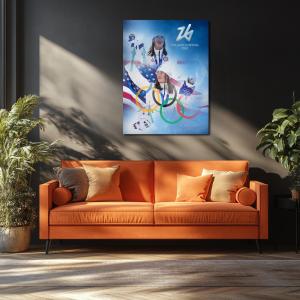
Sapphire Continuum captures Madison Chock and Evan Bates’ Milano Cortina 2026 performances through disciplined chromatic structure and verified Olympic precision. In the Team Event at the Milano Ice Skating Arena, they scored 89.72 (TES 51.54 / PCS 38.18) in the Rhythm Dance on February 6 and won the Free Dance with 133.23 (TES 75.37 / PCS 57.86) on February 7, earning 9 and 10 placement points to secure Team USA’s gold. In the Individual competition, their Free Dance score of 134.67 (TES 76.75 / PCS 57.92) produced a total of 224.39 and Olympic silver. Through layered sapphire tones symbolizing technical rigor and softened cobalt fields representing artistic interpretation, the painting transforms official protocol into enduring equilibrium.
Please see Below for Details…


Hotline Order:
Mon - Fri: 07AM - 06PM
404-872-4663
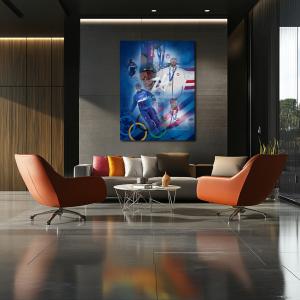
A vertical column of deep sapphire rises through the composition like a stabilizing spine, and along that axis Madison Chock and Evan Bates extend their arms beneath the American flag — not in spectacle, but in calibrated affirmation. This second rendering preserves their Milano Cortina 2026 legacy with the same structural precision that defined their skating: balance before flourish, alignment before applause, mathematics before myth. It is not merely an image of victory; it is a document of equilibrium sustained across multiple Olympic stages.
Madison Chock, born July 2, 1992, in Redondo Beach, California, and Evan Bates, born February 23, 1989, in Ann Arbor, Michigan, entered the XXV Olympic Winter Games as one of the most technically mature partnerships in international ice dance. Training in Montreal under Marie-France Dubreuil, Patrice Lauzon, and Romain Haguenauer, they embodied the defining traits of the Montreal school: blade depth, rotational stability, nuanced lift entries, and choreographic sophistication shaped by nearly fifteen years of partnership since forming in 2011. Their marriage in 2024 further solidified a partnership already distinguished by trust and mechanical synchronization — visible in mirrored knee compression, identical free-leg extension, and seamless breath-timed twizzle sequences.
The Team Event unfolded at the Milano Ice Skating Arena (Forum di Milano), where ice dance once again functioned as a structural anchor within the eight-segment Olympic format. On February 6, 2026, in the Team Event Rhythm Dance, Chock & Bates delivered a composed and technically secure performance, placing second with a score of 89.72. That total comprised a Technical Element Score (TES) of 51.54 and a Program Component Score (PCS) of 38.18, with zero deductions recorded in the official ISU protocol. The TES reflected levelled twizzles, a rotational lift executed with positive Grade of Execution values, and a precisely articulated step sequence. The PCS registered skating skills, transitions, performance, composition, and interpretation — the interpretive architecture of ice dance measured against international standards. Their second-place finish translated into 9 placement points for Team USA, establishing stable momentum in the team scoring calculus.
The following evening, February 7, 2026, they returned for the Team Event Free Dance — a flamenco-infused interpretation of “Paint It Black” defined by sustained edge pressure and sculpted upper-body phrasing. The official segment score: 133.23, comprised of TES 75.37 and PCS 57.86, again without deductions. The increase in TES reflected high-difficulty lift levels, complex step transitions, and synchronized rotational elements evaluated favorably by the judging panel. The PCS demonstrated compositional maturity and interpretive clarity under Olympic pressure. That first-place finish earned the maximum 10 placement points, materially reinforcing Team USA’s cumulative total and contributing directly to the eventual Olympic Team Gold medal.
Under the Olympic Team Event system, placements — not raw scores alone — determine medal outcome. Points are awarded 10 for first, 9 for second, 8 for third, and so forth. The combined 9 points from the Rhythm Dance and 10 from the Free Dance formed a 19-point contribution from ice dance, strengthening Team USA’s structural advantage over Japan and Italy. Ice dance, often decided by tenths of a point, becomes strategically decisive in the team format; Chock & Bates provided precisely that stability.
Four days later, within the same arena, the Individual Ice Dance competition recalibrated the stakes. In the Individual Rhythm Dance, Chock & Bates again scored 89.72 (TES 51.54 / PCS 38.18), demonstrating scoring consistency under a separate judging panel configuration. Their Individual Free Dance, however, registered a slightly elevated total of 134.67, composed of TES 76.75 and PCS 57.92. The incremental TES increase reflected marginally stronger execution and element valuation; the PCS improvement reflected interpretive nuance and compositional fluency. The combined competition total reached 224.39 — securing Olympic Silver, separated from gold by 1.43 points. In Olympic ice dance mathematics, such a margin is microscopic yet decisive, underscoring the precision required at the highest tier of competition.
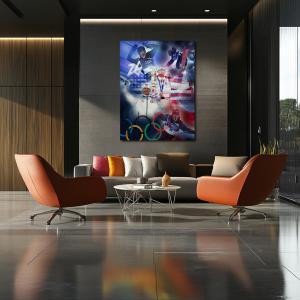
Chromatically, Sapphire Continuum shifts emphasis from diagonal velocity to vertical endurance. Sapphire remains dominant, but here it functions as continuity rather than propulsion. Deep ultramarine fields symbolize TES — angular, crystalline, objective. Cobalt and slate gradients represent PCS — fluid, atmospheric, interpretive. These color divisions mirror the ISU scoring dichotomy between technical execution and artistic composition. Where ultramarine cuts sharply across the canvas, cobalt diffuses gently, acknowledging the layered complexity of performance evaluation.
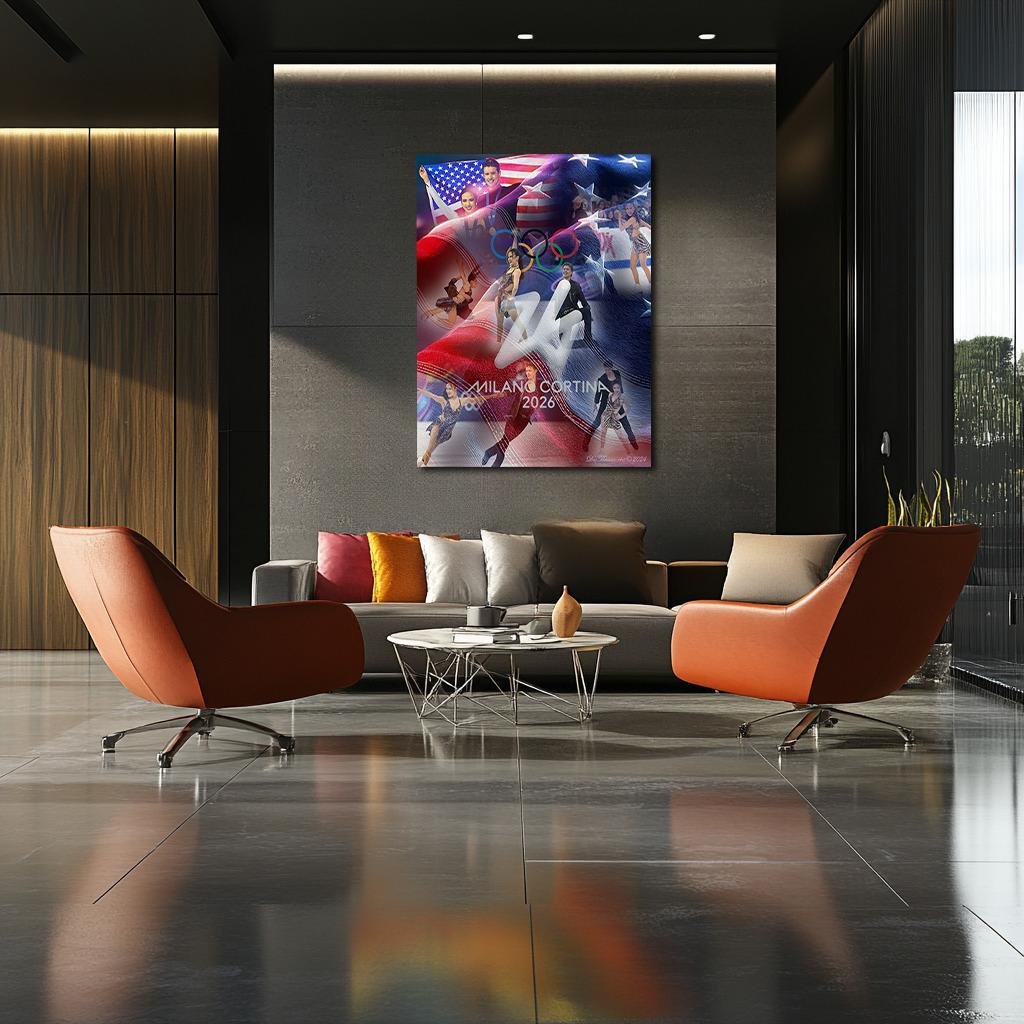
Red, drawn from the American flag, flows across the midplane in softened saturation. It does not overwhelm; instead, it pulses beneath the surface, reflecting the flamenco intensity of their Free Dance choreography. Red symbolizes contained passion — emotional fire disciplined within competitive boundaries. White streaks arc through the composition like blade tracings across ice, representing purity of edge and alignment. They also evoke renewal, a reminder that Olympic cycles are chapters within longer athletic careers.
Gold appears sparingly — restrained halos around the team medal moment, subtle rim-lighting across shoulders. This deliberate limitation reflects proportionality: team gold is celebrated, yet the painting acknowledges the luminous tension of individual silver. Silver itself is implied through cooler highlights — a quieter radiance, reflective rather than declarative.
Visually, the composition layers three temporal exposures: a rotational twizzle captured mid-axis (circular geometry), an extended lift (linear counterbalance), and a podium stance beneath the flag (triangular equilibrium). These geometric forms correspond directly to scoring architecture: circular twizzles mirror rotational TES accumulation; linear lifts represent extension and level attainment; triangular podium framing symbolizes final ranking structure. The repeated appearances of the couple compress February 6, February 7, and the individual final into a singular continuum — not isolated events, but phases of sustained equilibrium.
Subtle tonal variation in the upper register of the painting acknowledges the 1.43-point margin separating silver from gold. It is not dramatized; instead, it manifests as a nearly imperceptible shift in blue density — a reminder that Olympic destiny can pivot on fractional valuation. This micro-variance symbolizes judging nuance rather than controversy, reflecting the delicate subjectivity embedded within PCS scoring.
From a craft perspective, light is rendered with analog softness — halated beams rather than digital glare — preserving human warmth within institutional structure. Edges are feathered selectively to evoke the melt of emotion beneath composure. The Olympic rings at the lower field are translucent rather than dominant, reinforcing institutional permanence without disrupting the compositional equilibrium.
As the artist, I approached this piece as a study in structural restraint. Ice dance at the Olympic level is not theatrical excess; it is calibrated expression. Sapphire dominates because blue embodies discipline and psychological steadiness — the emotional temperature required for Olympic execution. Ultramarine reflects TES precision; cobalt embodies PCS interpretation. Crimson underlayers convey passion contained within regulation. Gold marks culmination without overpowering narrative subtlety.
This painting is not an exaltation of victory alone; it is a meditation on durability. Chock & Bates’ partnership since 2011, their Montreal coaching lineage, their marriage in 2024, and their sustained competitive relevance across Olympic cycles are embedded within the layered brushwork. The verified numbers — 89.72, 133.23, 134.67, 224.39 — function as structural beams anchoring the visual architecture.
Ultimately, Sapphire Continuum affirms that equilibrium defines greatness. In Milano Cortina 2026, Chock & Bates demonstrated that technical exactitude and artistic resonance can coexist within a single vector. Geometry and emotion align; color and calculation merge; silver and gold occupy adjacent planes within the same spectrum. This artwork preserves that continuum — precise, restrained, enduring.
Add your review
Your email address will not be published. Required fields are marked *
Please login to write review!
Looks like there are no reviews yet.