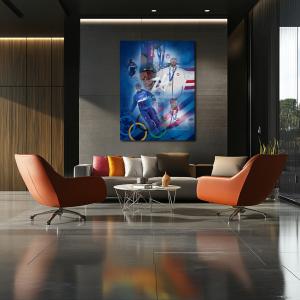


Sapphire Vector: Amber Glenn and the Calculus of Eight Points
A surge of sapphire light frames Amber Glenn’s decisive 138.62 in the Women’s Free Skate on February 8, 2026, a performance that earned 8 crucial placement points for Team USA in the Olympic Team Event at Milano Cortina. Born October 28, 1999, in Plano, Texas, Glenn is a triple Axel competitor, openly bisexual advocate, and national champion whose resilience defined her Olympic ascent. Her TES of 70.91 and PCS of 67.71 helped secure Team USA’s gold medal. Through layered cobalt gradients, flag-driven diagonals, and compressed moments of glide and celebration, this artwork transforms a precise Olympic protocol entry into a luminous chronicle of endurance, velocity, and collective triumph.
Please see Below for Details…


Hotline Order:
Mon - Fri: 07AM - 06PM
404-872-4663
A streak of electric sapphire cuts across the composition like a blade etching certainty into Olympic ice, and within that forward surge Amber Glenn extends into motion — chin lifted, arms balanced, edge clean and uncompromising. This artwork distills her contribution to Team USA’s gold medal in the Figure Skating Team Event at the XXV Olympic Winter Games — Milano Cortina 2026, transforming verified protocol sheets and segment mathematics into chromatic permanence.
Amber Glenn was born on October 28, 1999, in Plano, Texas, United States. Raised in Texas — far from the traditional epicenters of American figure skating — she began skating at five years old. Her development unfolded in regional training environments where internal drive compensated for geographic distance from established winter sport infrastructures. That separation shaped a competitive temperament rooted in resilience rather than system inheritance. Through her junior and senior progression, she trained under evolving coaching structures, refining air position mechanics, tightening rotational snap, and stabilizing landing edges. Over time, her technical identity became closely associated with the triple Axel, a forward takeoff jump requiring three and a half airborne rotations. In the modern ISU era, few American women have consistently attempted the triple Axel in international competition. Its elevated base value and high-risk profile mirror Glenn’s assertive skating style — forward-entry commitment, velocity through takeoff, and willingness to embrace technical volatility.
Her competitive résumé includes Grand Prix assignments, U.S. National podium finishes, and eventual national championship success in the mid-2020s, achievements that solidified her Olympic candidacy for 2026. Yet Glenn’s biography extends beyond technical elements. In 2019, she publicly came out as bisexual, becoming one of the most visible openly LGBTQ+ athletes in American figure skating. She has spoken candidly about living with ADHD and navigating competitive anxiety, bringing transparency to a discipline often defined by aesthetic control and emotional containment. Her advocacy for mental health awareness and authenticity has become inseparable from her competitive identity.
The Olympic Figure Skating Team Event at Milano Cortina 2026 took place at the Forum di Milano (Mediolanum Forum) in Milan, Italy. The event comprised eight segments across four disciplines: Women’s Short Program and Free Skate, Men’s Short Program and Free Skate, Pairs Short Program and Free Skate, and Ice Dance Rhythm Dance and Free Dance. Teams earned placement points per segment — 10 for first, 9 for second, 8 for third, and so forth — with cumulative placement totals determining medal standings. The final podium reflected a tightly contested scoring architecture: United States secured gold, Japan earned silver, and Italy claimed bronze.
On February 8, 2026, Amber Glenn competed in the Women’s Free Skate segment of the Team Event. She was strategically substituted into the Free Skate following Alysa Liu’s Short Program performance, in accordance with Olympic team substitution rules that permit roster optimization between segments. Glenn placed third in the Women’s Free Skate with a total score of 138.62. Her Technical Element Score (TES) was 70.91, and her Program Component Score (PCS) was 67.71. That placement earned 8 critical team points, directly contributing to the United States’ cumulative gold medal total.
Figure skating is not evaluated by time in the manner of racing disciplines. While Free Skate programs must fall within regulated duration — approximately four minutes — scoring is derived entirely from executed elements and artistic evaluation under the ISU Judging System. Glenn’s TES of 70.91 reflects jump base values, Grade of Execution adjustments, spin level difficulty, step sequence level, and element combinations. Her PCS of 67.71 reflects skating skills, transitions, performance, composition, and interpretation. The combined total of 138.62 positioned her third in the segment behind Kaori Sakamoto of Japan and Anastasiia Gubanova of Georgia. In team format mathematics, however, third place equaled structural sufficiency. Those 8 points stabilized Team USA’s scoring trajectory and preserved gold.
Chromatically, blue dominates the artwork in layered gradations — deep ultramarine, cobalt intensity, glacier cyan. Blue symbolizes discipline, psychological regulation, and winter atmosphere. In Glenn’s context, blue becomes biography — years of recalibration, technical rebuilding, and sustained resilience. Diagonal sapphire vectors traverse the canvas like blade tracings carved into ice, suggesting velocity and directional force. These compositional lines propel the viewer’s gaze upward, mirroring athletic ascent and cumulative scoring momentum.
In the lower register, Glenn appears in her Free Skate costume rendered in dark navy and black with sheer detailing. Black absorbs light and symbolizes gravity, internal focus, and technical weight. Navy bridges shadow and illumination, representing effort transitioning into recognition. Above, the luminous white of her Team USA podium jacket radiates ceremonial legitimacy. White contrasts sharply with the saturated blues, symbolizing earned clarity and institutional acknowledgment.
The American flag arcs dynamically overhead, its red representing competitive courage and forward aggression, its white embodying renewal and honor, and its blue integrating national identity with Olympic universality. The Olympic rings anchor the lower quadrant in official sequence, formalizing global context and reminding the viewer that this moment exists within structured governance. Gold radiance emanates subtly around the medal moment. Gold here symbolizes culmination — yet the glow remains measured and dignified, reflecting the restrained grandeur of winter Olympic ceremony staging.
Multiple exposures layer Glenn in glide extension, in rotational suspension, and in podium celebration. This compression of time mirrors the scoring equation itself: technical risk combined with artistic interpretation yields competitive identity. Her 138.62 is not abstract symbolism; it is the numeric convergence of mechanical precision and expressive phrasing. It represents attack balanced by control.
Born in Plano. Raised in Texas. Openly bisexual. ADHD advocate. Triple Axel competitor. National champion. Olympic gold medalist. Glenn’s path to Milano Cortina was not uninterrupted dominance; it was iterative refinement. She rebuilt jump consistency during a stage of career when many skaters exit elite competition. Her Olympic selection carried both technical legitimacy and narrative durability.
Her 8 placement points on February 8 were not supplementary; they were structural. In team event calculus, each segment shifts medal color. Glenn’s third-place finish provided the precise equilibrium Team USA required.
Ice flows into edge. Edge flows into athlete. Athlete lifts the flag. The flag aligns beneath the rings. The rings dissolve into sapphire horizon. Ice represents labor. Edge represents technique. Athlete represents identity. Flag represents belonging. Rings represent global governance. Sapphire horizon represents enduring Olympic memory.
Sapphire Vector records the moment in exact terms: February 8, 2026; Forum di Milano; score 138.62; TES 70.91; PCS 67.71; placement third; 8 points earned; outcome Team USA gold. Through cobalt gradients and directional velocity lines, the artwork transforms competitive arithmetic into visual permanence. Amber Glenn’s Free Skate was not the highest score of the segment — but it was precisely calibrated to secure the structure the team required. In Olympic mathematics, calibrated precision becomes gold.
Add your review
Your email address will not be published. Required fields are marked *
Please login to write review!
Looks like there are no reviews yet.