
Sapphire Vector: Chock & Bates — Precision, Points, and the Quiet Geometry of a Silver Edge
A sapphire diagonal frames Madison Chock and Evan Bates’ Olympic arc: in the Team Event at the Milano Ice Skating Arena they delivered a Rhythm Dance of 89.72 (TES 51.54 / PCS 38.18) on 6 Feb 2026 and a top Team Free Dance of 133.23 (TES 75.37 / PCS 57.86) on 7 Feb 2026, securing vital placement points that helped Team USA win the team gold. In the Individual competition their Free Dance scored 134.67 (TES 76.75 / PCS 57.92), producing a combined total of 224.39 and the Olympic silver. Coached by Marie-France Dubreuil, Patrice Lauzon and Romain Haguenauer, the couple’s layered exposures in the painting literalize TES as crystalline ultramarine and PCS as softened cobalt — technical precision meeting interpretive warmth — while the ISU protocol PDFs and official Olympic results preserve every numeric detail.


Hotline Order:
Mon - Fri: 07AM - 06PM
404-872-4663
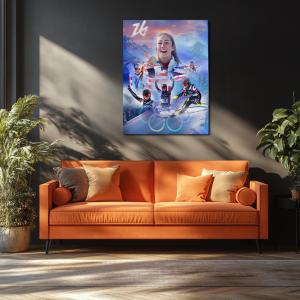
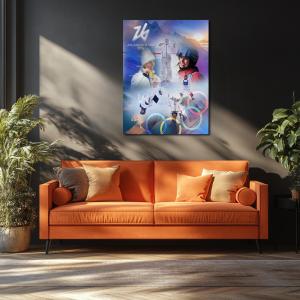
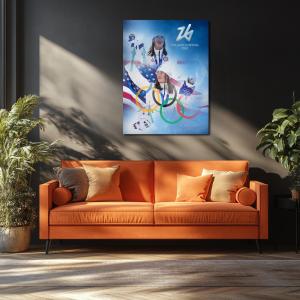
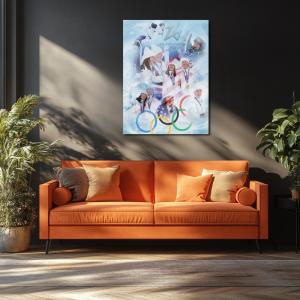
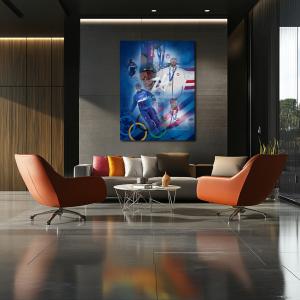
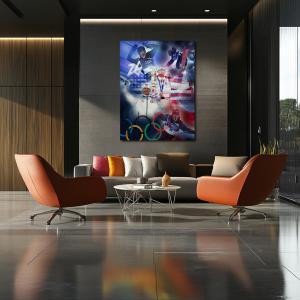
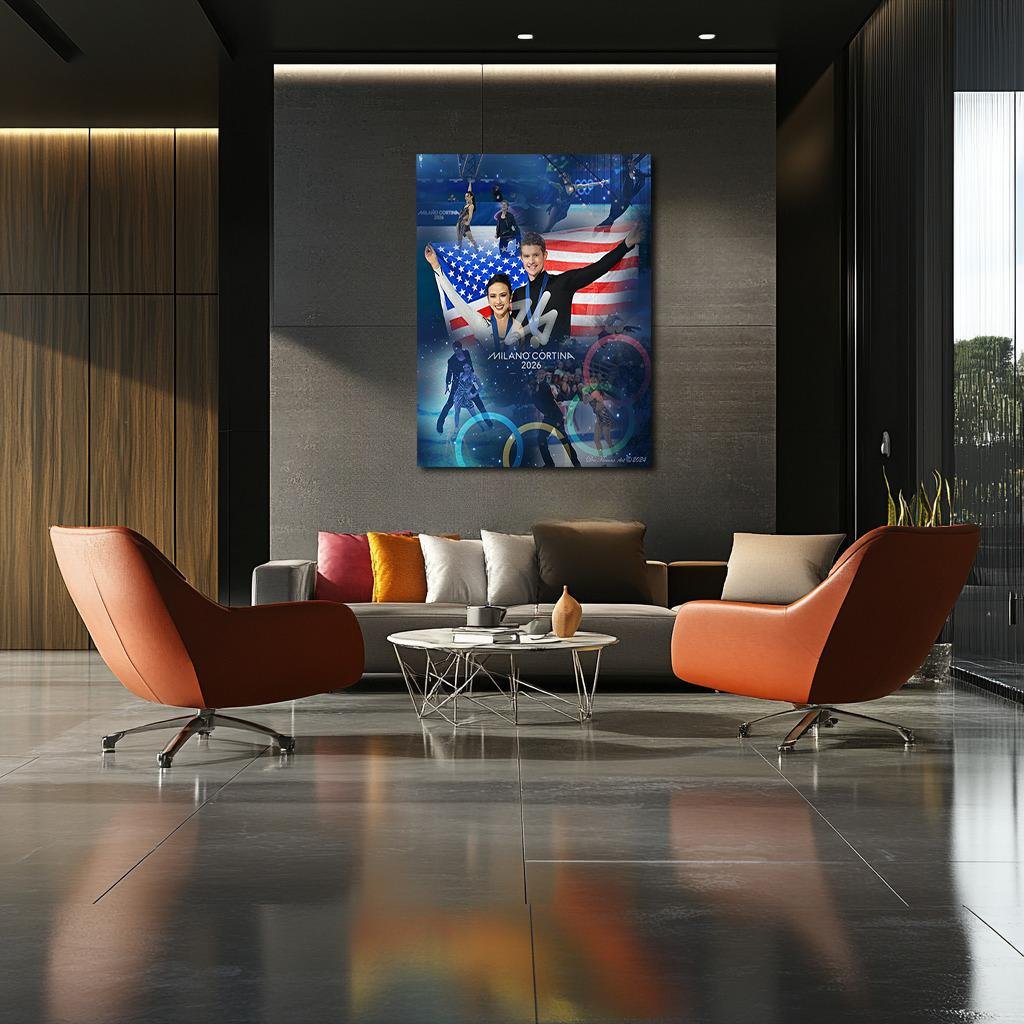
A single diagonal of saturated sapphire slices the frame — a composed axis around which Madison Chock and Evan Bates unfold their skate: shoulders coiled, edges sliced, bodies aligning in exacting geometry. This artwork distills their Milano Cortina 2026 arc into chromatic law — measured risk, intentional line, and the arithmetic of placement. It records, precisely and artistically, their Team Event contributions and their individual Olympic fight for gold that finished as silver by the narrowest of margins.
Madison Chock (born July 2, 1992, Redondo Beach, California) and Evan Bates (born February 23, 1989, Ann Arbor, Michigan) train in Montreal with coaches Marie-France Dubreuil, Patrice Lauzon, and Romain Haguenauer — a coaching group that has shaped their modern technical polish and expressive architecture on ice. Their training town and coaching pedigree are part of the visual DNA of the piece: Montreal’s clean lines, persistent edge quality, and the Dubreuil/Lauzon/Haguenauer school’s signature combination of precision and passionate projection are translated into the painting’s repeated axe-like strokes.
In the Team Event the ice was the stadium’s measured stage: the Milano Ice Skating Arena hosted the ice dance rhythm dance on February 6, 2026, and the team free-dance segment on February 7, 2026. The ISU protocol shows Madison Chock and Evan Bates placed 2nd in the Team Event Rhythm Dance with a total segment score of 89.72, composed of a Total Element Score (TES) of 51.54 and a Total Program Component Score (PCS) of 38.18, with zero deductions — an RD performance whose technical objectivity and component refinement read numerically as balance and intent. Those values are recorded in the official ISU Judges’ Details per Skater for the Rhythm Dance.
The team Free Dance for the Team Event — the next night — was an ensuing statement: Chock & Bates won the Team Event Free Dance segment with a segment total of 133.23, comprised of TES 75.37 and PCS 57.86, again with no deductions; that first-place Free Dance segment earned the United States the maximum placement points available for that segment, and decisively supported Team USA’s march to the team gold. The Team Event Free Dance protocol is preserved in the ISU Team Event Free Dance judges’ report.
Under the team scoring rules (placement points per segment, with 10 for first, 9 for second, 8 for third, etc.), Chock & Bates’ RD and Team-FD placements provided critical placement points (9 points for their RD placement and 10 points for the Team FD win) that fed directly into Team USA’s cumulative total which ultimately won the team gold at the Milano Cortina Team Event. The ISU team-event reports and final team standings record the U.S. finishing atop the Team Event podium following that cumulative arithmetic.
Four days later, in the Individual Ice Dance competition at the same Milano Ice Skating Arena, Chock & Bates skated to the long program that would decide Olympic individual medals. In the Individual Event their Rhythm Dance again registered 89.72 (RD TES 51.54 / PCS 38.18 per the official RD protocol), and their Individual Free Dance performance received a free-dance segment score of 134.67, composed of TES 76.75 and PCS 57.92, producing a combined total of 224.39 for the competition. That total placed them second overall, a silver medal separated from gold by a hairline margin (the final French winning total was 225.82). These exact splits and combined totals are present in the ISU Judges’ Details and the Olympic results summary.
Chromatically, the painting uses a hierarchy of blues — glacier cyan for the ice’s reflective plane, ultramarine for concentrated focus, and electric sapphire for kinetic lines carved by blades. Those blues map to technical meanings: TES is rendered as crystalline ultramarine, the cold geometry of jump and lift execution and GOE nuance; PCS is represented with softer glazes of cobalt and slate, symbolizing interpretive breadth, timing, musicality and composition. Gold is used sparingly — ringed glows around the team podium and shallow rim-lighting on the couple — to signify cumulative achievement (team gold) and the paradoxical fragility of medal outcomes (individual silver). Red is a low-saturation underpaint — emotional heat threaded into their choreography’s flamenco and paso-doble instincts — and the flag motif is consciously restrained so the composition remains about edge and duet rather than nationalist exclamation.
Visually the couple appears in layered exposures: a tight twizzle sequence captured mid-rotation (a vertical spiral of sapphire), a sweeping lift with the male line extending like a caliper, and finally a still podium moment where the couple’s bodies form a contained V. This temporal compression mirrors the ISU scoring calculus — element base values and GOEs (aggregated in TES) intersect with program components (PCS) to produce the final numeric signature. Where the Team Event free dance recorded 133.23 (TES 75.37 / PCS 57.86) and secured the segment’s top placement, the Individual Free Dance score of 134.67 (TES 76.75 / PCS 57.92) indicates a slightly different execution and valuation by the judging panels on the competition day — differences the ISU reports make visible in individual GOE lines and component tallies.
The work also acknowledges the broader context: Chock & Bates’ individual silver provoked discussion about judging margins and panel variance after the Free Dance; media coverage and the ISU’s public statements about judging safeguards make clear that, although five of nine judges scored the Americans higher than the French pair, a single wide margin from one judge shifted the arithmetic enough to change the gold/silver ordering — a controversial microhistory that the painting renders as a barely perceptible, but telling, variance in tone along the upper right edge. This gap — aesthetic, numerical, human — is part of the Olympic narrative in 2026.
From a craft standpoint, the artist emphasized restraint: the textured lights are analog in feel (soft halation from arena beams), not hyper-digital glare; edges are feathered in places where the ice’s melt of emotion should be felt; compositional diagonals map to placement arithmetic (RD → FD → combined total). The painting lists exact numeric anchors, integrated visually and typographically into the lower margin — Rhythm Dance: 89.72 (TES 51.54 / PCS 38.18) on 6 Feb 2026; Team Free Dance: 133.23 (TES 75.37 / PCS 57.86) on 7 Feb 2026 (team points awarded per placement); Individual Free Dance: 134.67 (TES 76.75 / PCS 57.92) producing Total 224.39 (individual silver), all performed at the Milano Ice Skating Arena and recorded in the ISU protocol reports.
As the artist, I approached this painting as an exploration of balance rather than drama. Sapphire dominates the composition because blue embodies discipline, stability, and controlled velocity — the essential qualities of elite ice dance. The deepest ultramarine passages represent TES: the crystalline precision of twizzles, lifts, and edge depth evaluated under objective criteria. The softer cobalt and slate glazes represent PCS: interpretation, musical phrasing, composition, and the emotional resonance of movement. In this hierarchy, technical precision is sharp and angular; artistic expression is diffused and atmospheric.
Finally, human detail: Chock & Bates’ competitive identities — their long partnership (since 2011), three consecutive World titles in the lead-up years, their marriage in 2024 and their coaching with Dubreuil/Lauzon/Haguenauer — are not background ornament; they are structural timbres in the painting’s patina. The scores and dates are the hard geometry; the partnership’s longevity and training lineage are the lived texture. Both realities, numeric and human, sit together in the finished image: a sapphire vector of skill and time cutting through Olympic memory.
Add your review
Your email address will not be published. Required fields are marked *
Please login to write review!
Looks like there are no reviews yet.