

United by Ice and Altitude: The Measured Architecture of Team USA at Milano Cortina 2026
At Milano Cortina 2026, Team USA’s medalists across alpine skiing and figure skating defined Olympic distinction through measurable precision. Breezy Johnson captured Women’s Downhill gold in 1:36.10, separated by just 0.04 seconds over a 2.572-kilometer course with a 760-meter vertical drop. Ryan Cochran-Siegle earned Super-G silver in 1:25.45, only 0.13 seconds from gold. On the ice, Ilia Malinin secured individual gold with 309.14 points, while Chock & Bates earned silver and contributed 19 placement points to Team Event gold alongside Alysa Liu and Amber Glenn. Across snow and ice, altitude and rotation, hundredths and decimals shaped enduring Olympic geometry.
Please see Below for Details…


Hotline Order:
Mon - Fri: 07AM - 06PM
404-872-4663
Across the mountains of Bormio and Cortina and the luminous ice of Milan, Team USA’s medalists at the XXV Olympic Winter Games — Milano Cortina 2026 — carved their legacy in measurable increments. Vertical meters, course kilometers, rotational degrees, placement points, and fractions of seconds defined the distinction between podium tiers. This unified archive preserves those performances not as narrative highlights alone, but as structural events governed by physics, scoring systems, and chronometric precision.
The alpine slopes of northern Italy provided the gravitational stage. On 8 February 2026, at Olimpia delle Tofane in Cortina d’Ampezzo, Breezy Johnson delivered a single downhill run that became Olympic gold. The course presented a vertical drop of 760 meters, descending from 2320 meters to 1560 meters across a 2.572-kilometer track of hard-packed snow under clear skies. Starting with bib number 6, Johnson completed the descent in 1:36.10. The margin separating gold from silver was 0.04 seconds. Bronze trailed by 0.59 seconds. Over 96.10 seconds of continuous velocity, the podium was compressed within less than six-tenths of a second. Downhill permits no recalibration — no second run, no cumulative correction. Johnson’s time is permanent. Over 2.572 kilometers, 0.04 seconds equates to mere meters at race speed — the difference of a single compression exit or aerodynamic micro-adjustment. Born January 19, 1996, in Jackson Hole, Wyoming, and raised in Victor, Idaho, Johnson’s Olympic victory represents culmination of resilience, including injury recovery and elite-level return to form following competitive interruption. Her gold at Milano Cortina 2026 added to Team USA’s alpine legacy and reinforced American presence in the speed disciplines.
Three days later, on 11 February 2026, at the Stelvio Ski Centre in Bormio, Ryan Cochran-Siegle continued that alpine narrative in the Men’s Super-G. The Stelvio course measured 2.414 kilometers with a vertical drop of 714 meters, descending from 1959 meters to 1245 meters in –3.3 °C air over hard-packed conditions. Super-G, like downhill, is decided in a single run. Cochran-Siegle’s official time of 1:25.45 placed him 0.13 seconds behind gold and 0.15 seconds ahead of bronze. The entire podium was separated by 0.28 seconds. Over an 85.45-second descent, 0.13 seconds represents approximately three to four meters of terrain. Born March 27, 1992, in Burlington, Vermont, and son of 1972 Olympic gold medalist Barbara Cochran, Cochran-Siegle carried lineage into modern speed architecture. His silver medal at Milano Cortina marked sustained elite performance across Olympic cycles and reaffirmed the United States’ structural consistency in alpine racing.
While gravity defined alpine results, ice defined the geometry of figure skating. At the Milano Ice Skating Arena, Team USA’s figure skaters translated rotational mechanics and artistic composition into placement mathematics.
In the Figure Skating Team Event, eight segments across four disciplines determined cumulative outcome. Alysa Liu contributed decisively in the Women’s Short Program, posting 74.90 and earning 9 placement points. Though substituted for the Free Skate segment per Olympic team rules, her structural contribution anchored the United States’ path to gold. Amber Glenn added strength in the Women’s Free Skate with 138.62 (TES 70.91 / PCS 67.71), securing 8 additional placement points. The team scoring system awards 10 points for first, 9 for second, 8 for third, and so forth; cumulative placement arithmetic determines medal color. Through combined efforts across men, women, pairs, and ice dance, Team USA secured Olympic Team Gold in figure skating.
Madison Chock and Evan Bates were central to that gold. In the Team Event Rhythm Dance on 6 February 2026, they scored 89.72 (TES 51.54 / PCS 38.18), earning 9 placement points. On 7 February, their Team Free Dance scored 133.23 (TES 75.37 / PCS 57.86), earning the maximum 10 placement points for that segment. Their combined 19 placement points provided structural reinforcement within the cumulative team total. Born July 2, 1992 (Chock, Redondo Beach, California) and February 23, 1989 (Bates, Ann Arbor, Michigan), and partnered since 2011, their competitive maturity reflects nearly fifteen years of synchronized development under Montreal coaches Marie-France Dubreuil, Patrice Lauzon, and Romain Haguenauer. Married in 2024, their partnership merges personal and technical trust into rotational symmetry and edge precision.
In the Individual Ice Dance competition, Chock & Bates again delivered 89.72 in the Rhythm Dance and 134.67 in the Free Dance (TES 76.75 / PCS 57.92), producing a total of 224.39 and earning Olympic Silver. The margin separating silver from gold was 1.43 points — microscopic within elite scoring ranges. In ice dance, as in alpine, hundredths and decimals govern outcome.
Ilia Malinin extended American figure skating dominance in the Men’s discipline. In the Team Event, he delivered 104.58 in the Short Program and 198.76 in the Free Skate, generating maximum placement contributions. In the Individual competition, his total of 309.14 (106.03 + 203.11) secured Olympic Gold. Born December 2, 2004, in Arlington, Virginia, Malinin represents a new generation of technical ambition. His performances fused rotational complexity and compositional fluency under ISU judging criteria, where TES reflects jump base values and execution, and PCS reflects skating skills, transitions, performance, composition, and interpretation.
Collectively, these alpine and figure results share structural parallels. In alpine, vertical drop and course length define physical constraints. In figure skating, program components and technical element values define evaluative architecture. Both disciplines compress outcome into measurable margins — 0.04 seconds, 0.13 seconds, 1.43 points. Both demand singular execution without revision. Both render finality in one descent or one skate.
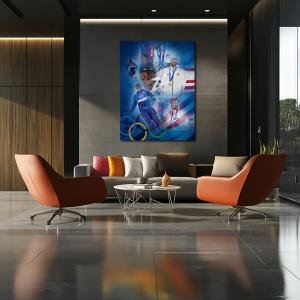
Chromatically, the unified narrative is rendered through glacial blues, crystalline whites, restrained crimson, and disciplined gold. Blue symbolizes altitude and composure — the 2320-meter downhill start, the calm before push-off, the mental clarity before a quad rotation. White embodies surface truth — snow integrity, ice plane, friction and edge hold. Red channels controlled aggression — acceleration in downhill, expressive fire in ice dance. Gold and silver radiate as measured consequence, not ornamental flourish.
Across 2.572 kilometers of downhill, 2.414 kilometers of Super-G, and four-minute free skates scored to hundredths and decimals, Team USA’s Milano Cortina 2026 medalists demonstrated that Olympic distinction is neither myth nor momentum alone. It is calculation aligned with courage. It is gravity negotiated through biomechanics. It is rotation stabilized through blade depth. It is 96.10 seconds, 85.45 seconds, 224.39 points, 309.14 points — each value recorded without revision.
The mountains measured descent.
The judges measured execution.
The clock confirmed distinction.
And across alpine slopes and Milan ice, Team USA inscribed its Milano Cortina 2026 legacy in fractions that will endure far longer than the snow that bore them.
Add your review
Your email address will not be published. Required fields are marked *
Please login to write review!
Looks like there are no reviews yet.