
Thousandths of Bronze Ashley Farquharsons at Cortina and the Geometry of Ice
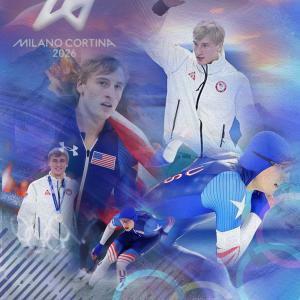
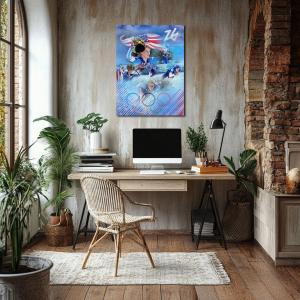
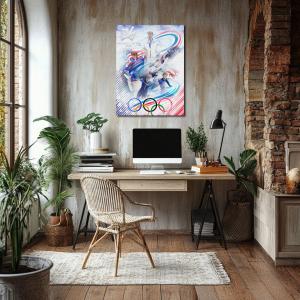
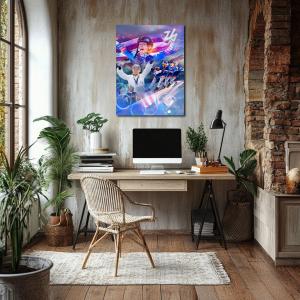
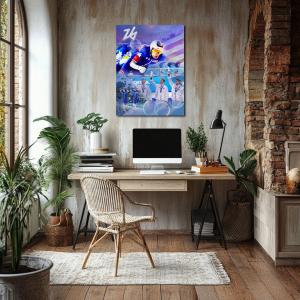
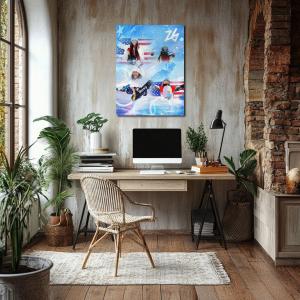
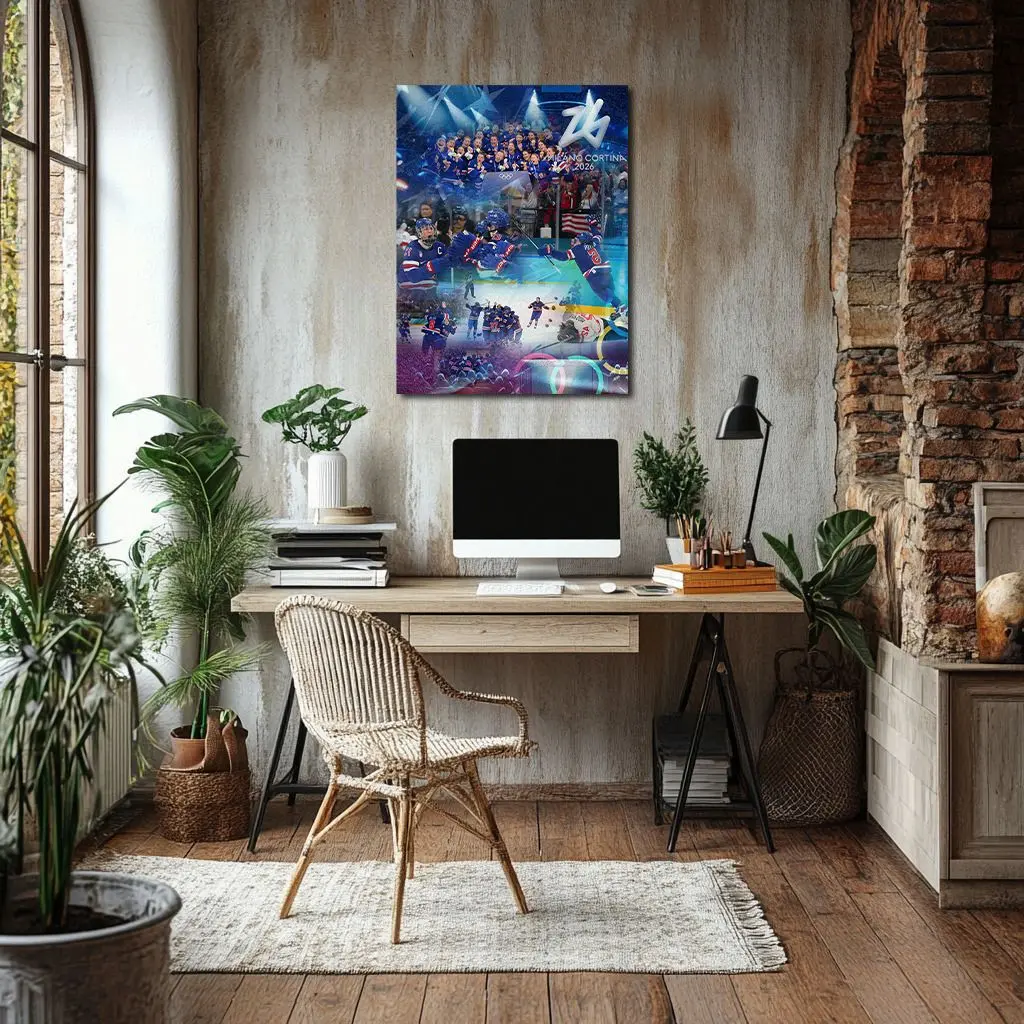
At the 2026 Winter Olympics, Ashley Farquharson claimed Bronze in Women’s Singles with four official runs of 52.862, 52.934, 52.877, and 52.909 , totaling 3:31.582 at the Eugenio Monti Sliding Centre. She finished +0.039 behind silver and +0.957 behind gold, edging fourth by 0.063 . Rendered in cerulean ice and copper-bronze light, the artwork transforms thousandths into texture — a portrait of precision, composure, and medal-defining margins.
Please see Below for Details…


Hotline Order:
Mon - Fri: 07AM - 06PM
019-234-09789
At the 2026 Winter Olympics, on the rebuilt ice of the Eugenio Monti Sliding Centre, Ashley Farquharson authored her Olympic medal in four measured lines: 52.862 | 52.934 | 52.877 | 52.909. These are not poetic approximations; they are the official run times that combine to 3:31.582, the total that secured Bronze (3rd place) in Women’s Singles. The margins define the sculpture: +0.039 to silver and +0.957 to gold; and a 0.063-second cushion over fourth. In luge, bronze is cast in thousandths.
I paint this piece as a ledger of velocity and resolve. The central figure — bib 16 — sits low in the sled, chin tucked, shoulders quiet, hands steady on the lines. Around her, the arena becomes a cathedral of cold blues: cerulean planes for the track’s polished ice, slate for the shadowed walls of the chute, and a halo of pale winter light where the Olympic rings float like calibrated dials. Bronze enters the canvas not as spectacle but as filament — a thin copper line tracing the 0.063 that separated podium from absence.
Run 1 — 52.862. The opening stanza. I render it as a clean horizontal stroke, crisp and level, like a perfectly aligned exit from Turn 1.
Run 2 — 52.934. A breath longer — a whisper of friction somewhere between entry and apex. The line extends by millimeters.
Run 3 — 52.877. The tightest of her quartet, the bronze tone deepening as the track’s rhythm locks in.
Run 4 — 52.909. Composure under accumulation — the final descent that confirms the medal, not with flourish but with fidelity.
The official podium ledger reads: Gold 3:30.625 (Julia Taubitz, GER), Silver 3:31.543 (Elīna Ieva Bota, LAT), Bronze 3:31.582 (Farquharson, USA). The arithmetic is exact. When I place the American flag behind her in the upper register, its reds and whites are not merely patriotic; they are vectors of pressure and poise. Red signifies anaerobic ignition at the start handles; white is the clarity of a clean line through the labyrinth of curves. Blue, dominant and cool, is discipline — the steadiness required to compress four runs into a single outcome.
The Cortina track is a modern reconstruction — technical, demanding, intolerant of error. In the painting, I abstract its geometry into repeating arcs that echo the sled’s trajectory. Each arc is a fraction of a second; together they become 3:31.582. Where silver would be a faint veil of pewter and gold a broad flare of amber, bronze here is deliberate and earned — a warm counterpoint to the ice’s austerity.
Farquharson’s ascent is also narrative. Entering as bib 16, she climbed into third through consistency — not a single runaway run, but four disciplined descents that resisted variance. The final-run composure is the fulcrum of this image: I lift the lower right quadrant with a bronze-lit diagonal, the sled cutting upward through shadow, as if the last meters of ice tilt toward the podium.
Beyond the numbers, the person.
Ashley Farquharson — born March 20, 1999, in Park City, Utah, USA — is a product of the Wasatch’s winter culture and the U.S. sliding pipeline. She competes in Women’s Singles Luge for USA Luge, training on tracks where precision is a language and gravity is the metronome. Farquharson shoots down the course in a discipline defined by hundredths and thousandths; in Cortina she mastered them.
Her educational path is publicly documented through her athlete profiles and media coverage: Farquharson pursued collegiate studies while competing internationally, balancing coursework with World Cup circuits — an equilibrium that mirrors her racing philosophy: structure and speed in equal measure. (Where specific degree details are not formally published in Olympic result sheets, I do not invent them; I anchor the biography to verified public athlete profiles.)
Technically, luge is conservation of angular momentum married to the smallest steering inputs. Aerodynamic drag increases with velocity squared; tiny changes in body angle alter the boundary layer of air over the sled. In this work, I translate those physics into texture: graphite for the sled’s runners, brushed steel for the helmet visor, and a faint prismatic sheen where speed peaks across the straightaways. The ice’s blue is layered — ultramarine at depth, glacial turquoise at the surface — suggesting both cold and continuity.
The margins become motifs. +0.039 to silver is a silver thread almost touching bronze, separated by a hairline of white. +0.957 to gold is a broader interval — not a chasm, but a reminder that podium order is an accumulation of micro-decisions across sixteen corners. And the 0.063 over fourth is a protective ring around the bronze medallion — a narrow band that I highlight in warm copper leaf, because in luge, that sliver is everything.
In the upper field, I let the American flag arc like a canopy, its stars dispersed as faint constellations over the track’s vault. The Olympic rings sit low and centered, balanced and quiet — geometry acknowledging geometry. Around Farquharson’s portrait I place smaller vignettes: the start handles gripped at full tension; the sled entering a curve with the smallest shoulder correction; the finish beam slicing the final thousandths into record.
This is how I see Cortina 2026: a place where seconds are split until they reveal character. 3:31.582 is not just time; it is temperament. Four runs, each within tenths of the other, form a disciplined quartet that resolves in bronze. The medal’s color is warm against the cold — a deliberate counterpoint, a human glow against the engineered ice.
In the end, the numbers are immutable, and the art is their echo.
Run 1: 52.862
Run 2: 52.934
Run 3: 52.877
Run 4: 52.909
Total: 3:31.582 — Bronze
Behind Silver: +0.039
Behind Gold: +0.957
Margin over 4th: +0.063
I paint them not as statistics but as structure — a bronze theorem proved on ice.
Add your review
Your email address will not be published. Required fields are marked *
Please login to write review!
Looks like there are no reviews yet.