


The Founding Fathers and the Washington Monument as Guardians of America's Enduring Vision (1776–2026)
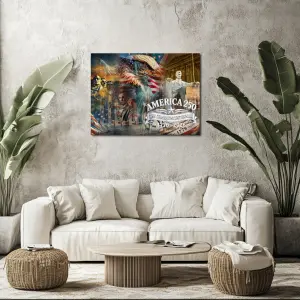
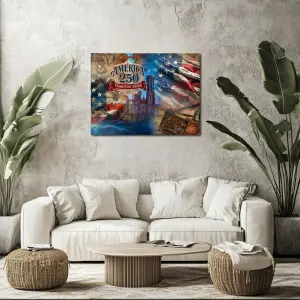
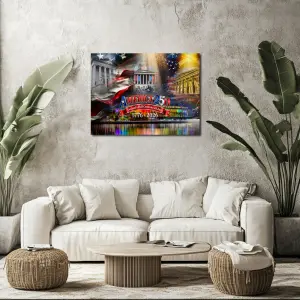
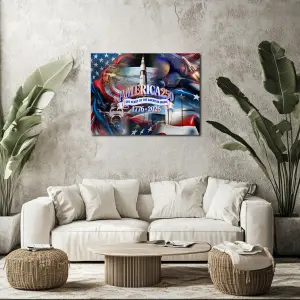
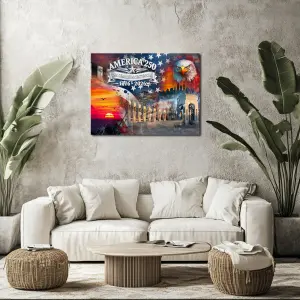
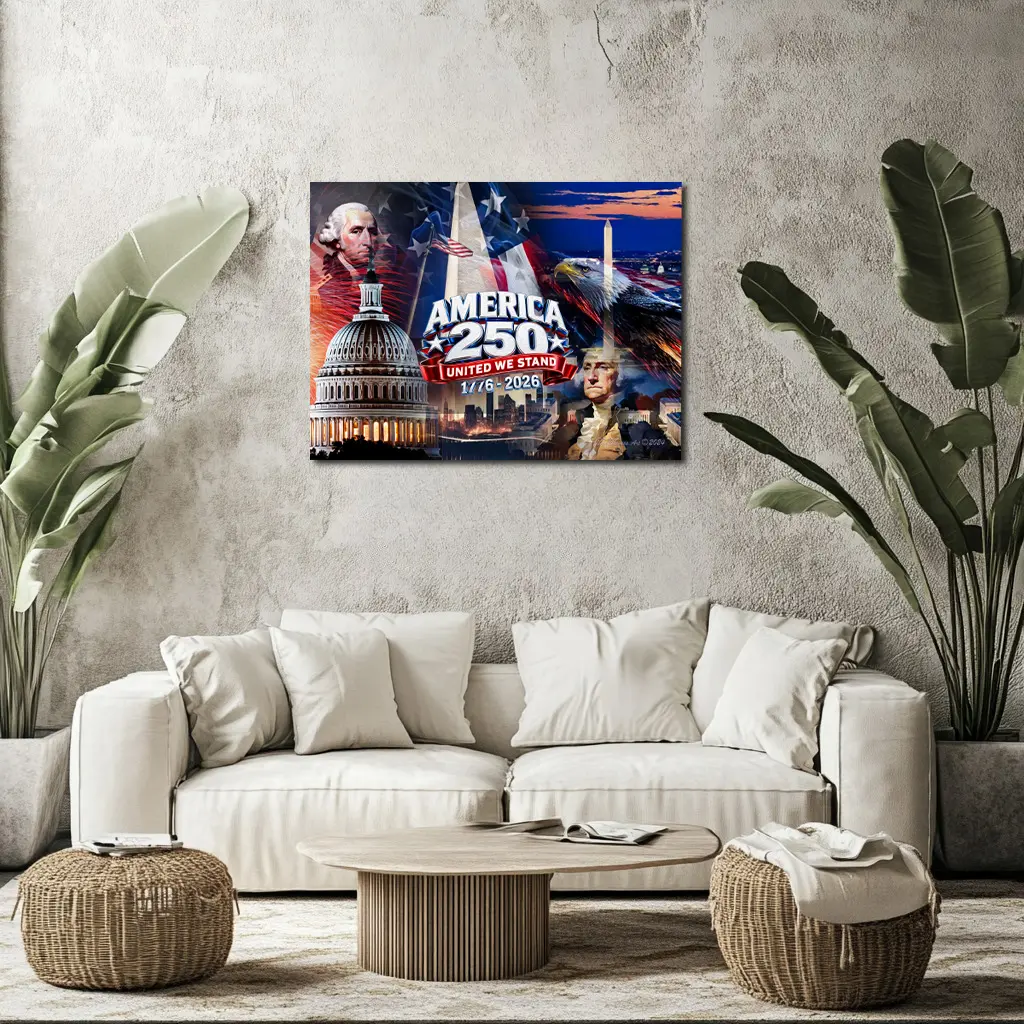
This artwork celebrates America's 250-year journey (1776–2026) by bringing together George Washington , the Washington Monument , the United States Capitol , the American flag , the bald eagle , and the America 250 emblem into a unified visual tribute to the nation's founding ideals. The description naturally weaves the history of each symbol—from Washington's leadership in the Revolutionary War and presidency, to the construction of the Capitol and Washington Monument, and the adoption of the bald eagle as the national emblem—showing how each contributed to the development of the United States. Rich patriotic colors, dramatic lighting, layered textures, and balanced composition reinforce themes of unity, constitutional government, resilience, and civic responsibility. Rather than simply honoring historical figures, the artwork presents the Founding Fathers as enduring guardians of a living republic whose principles continue to inspire and guide America into its next century.
Please see Below for Details…


Hotline Order:
Mon - Fri: 07AM - 06PM
019-234-09789
When I began creating this artwork, I wanted to honor the people whose courage transformed an idea into a nation. Every country has monuments, but behind every monument are individuals whose convictions shaped history. For America's 250th anniversary (1776–2026), I wanted this composition to become a visual conversation between the nation's founding generation and the generations that continue to carry their vision forward. The result is a tribute not only to the Founding Fathers and the Washington Monument, but also to the enduring ideals of unity, liberty, and national purpose that have guided the United States for two and a half centuries.
At the center of the composition stands the America 250 emblem bearing the powerful words "United We Stand." I placed this phrase at the heart of the artwork because it captures the spirit that made the American experiment possible. Independence was never achieved through one leader alone. It was the product of countless individuals who believed that unity could overcome division and that shared principles could build an entirely new republic.
Rising prominently on the left is the magnificent United States Capitol, its great dome illuminated with warm light. Although often associated with modern government, the Capitol represents the lasting legacy of the Founding Fathers. Construction began in 1793 under the leadership of President George Washington, who believed that the young republic deserved a seat of government worthy of its democratic ideals. Throughout more than two centuries, the Capitol has witnessed debates that shaped the nation's destiny, surviving war, expansion, social change, and political transformation while remaining the home of the people's representatives.
Looking over the Capitol is George Washington, whose calm expression reflects both determination and humility. I wanted his presence to feel less like a portrait and more like a guiding memory. Washington's place in American history extends far beyond becoming the nation's first President in 1789. As Commander-in-Chief of the Continental Army during the Revolutionary War, he led a determined but often under-equipped force to victory against one of the world's greatest military powers. His willingness to relinquish power after two presidential terms established one of the strongest traditions of democratic leadership—a peaceful transfer of authority that demonstrated the presidency would serve the Constitution rather than personal ambition. His example earned him the enduring title "Father of His Country."
Across the composition, the elegant silhouette of the Washington Monument rises into the evening sky. I wanted this soaring obelisk to connect the nation's earliest aspirations with its continuing future. Dedicated to George Washington, construction began in 1848, paused during years of political conflict and the Civil War, and was finally completed in 1884 before opening to the public in 1888. Standing over 555 feet (169 meters) tall, it remains the world's tallest predominantly stone obelisk and one of the most recognizable landmarks in the United States. Its simple geometric form reflects strength without extravagance, reminding us that greatness is often expressed through character rather than ornament.
Near the base of the monument appears another image of George Washington, this time dressed as the statesman rather than the military commander. I intentionally included two portrayals because Washington embodied two equally important roles. One secured American independence through leadership in war; the other secured its future through restraint in peace. Together they symbolize the remarkable balance between courage and wisdom that helped establish a constitutional republic capable of surviving beyond its founders.
The majestic bald eagle stretches across the right side of the artwork with unwavering focus. Officially adopted as the national emblem in 1782, the eagle represents freedom, sovereignty, courage, and resilience. I chose to portray it watching rather than attacking because the strength of a nation lies not only in power but also in vigilance. Its sharp eye overlooks both the Capitol and the Washington Monument, reinforcing the idea that liberty must always remain protected through awareness, responsibility, and civic participation.
Behind every symbol flows the American flag, wrapping the composition in movement and color. The thirteen stripes remind us of the original colonies that declared independence in 1776, while the fifty stars celebrate the Union that grew from those revolutionary beginnings. Rather than existing as a background decoration, the flag becomes the emotional thread connecting every historical figure and national institution represented in the artwork. Its movement suggests that the American story is never still. It continues to evolve with each generation.
The distant skyline of Washington, D.C., stretches across the lower portion of the composition, quietly linking history with the modern nation. I wanted contemporary buildings to emerge beneath these historic landmarks because America has never remained frozen in its founding era. Scientific discovery, technological innovation, economic growth, artistic achievement, and civic progress have all become chapters in the same national journey that began in 1776.
Color became the emotional language of this piece. Deep crimson honors the sacrifices made during the Revolution and by every generation that defended the republic afterward. Rich blues express stability, trust, and the enduring framework of constitutional government. Brilliant whites illuminate the Washington Monument and Capitol, symbolizing integrity, hope, and the pursuit of justice. Warm gold surrounding the historic figures suggests wisdom earned through experience, while the dramatic evening sky transitions from soft orange to deep indigo, representing the passage of time from the nation's birth to its 250th anniversary.
Lighting flows intentionally throughout the composition. The Capitol glows from within, symbolizing the enduring vitality of representative government. The Washington Monument catches the final light of the evening sky, becoming a beacon that bridges the nation's past and future. Gentle highlights define Washington's face, allowing him to emerge naturally from history rather than dominate it. The eagle reflects brilliant streaks of light that symbolize clarity of vision, while the shadows surrounding the skyline remind us that every generation has faced its own uncertainties. I wanted light and shadow to coexist because the American journey has always been shaped by both triumphs and challenges.
Texture enriches the visual experience. The weathered stone of the Capitol and Washington Monument reflects the endurance of national institutions. The soft fabric folds of the flag create movement and life. The detailed feathers of the eagle add realism and vitality, while the luminous metallic finish of the anniversary emblem introduces a contemporary commemorative element that connects history with the present celebration.
Compositionally, every element directs the eye toward the central anniversary emblem before encouraging exploration outward. The vertical lines of the Washington Monument echo the dome of the Capitol, creating visual balance between executive leadership and representative government. Washington's portraits frame the nation's origins, while the eagle and flag unite the entire composition into a single flowing narrative. Nothing competes for attention because every symbol contributes to one shared story—the creation and endurance of the American republic.
Artistically, I chose a style that blends historical realism with symbolic digital collage. Rather than illustrating one specific event, I layered centuries of American memory into one harmonious composition. Painterly textures, dramatic lighting, photographic detail, and rich color grading allow familiar national icons to speak to one another across time. My goal was to create an image that feels timeless while remaining deeply connected to the Semiquincentennial celebration.
The mood is proud, reflective, and quietly inspiring. I did not want this artwork to portray the Founding Fathers as distant heroes beyond history. Instead, I wanted them to feel like voices still participating in the national conversation. Their achievements established a foundation, but the responsibility of preserving liberty belongs to every generation that follows.
Every symbol carries a distinct historical and philosophical meaning. George Washington represents selfless leadership, civic virtue, and the willingness to place the nation above personal power. The Washington Monument stands as a lasting memorial to his character and to the ideals he helped secure. The United States Capitol reflects representative democracy and constitutional governance. The bald eagle symbolizes vigilance, independence, and national resilience. The American flag expresses unity across generations and states. The America 250 emblem reminds us that the nation's history is not merely remembered—it is continually renewed by the people who inherit it.
As the artist, I wanted this composition to remind viewers that monuments alone do not preserve history. Ideas do. The Founding Fathers gave America more than independence; they offered a framework of liberty, constitutional government, civic responsibility, and democratic participation that has endured through war, expansion, reform, and renewal. Those ideals remain as relevant today as they were in 1776.
Ultimately, "Architects of a Republic: The Founding Fathers and the Washington Monument as Guardians of America's Enduring Vision (1776–2026)" is my tribute to the remarkable individuals who imagined a nation founded on principles rather than privilege. It celebrates 250 years of perseverance, constitutional democracy, and national unity while looking toward a future that continues to be shaped by the same enduring belief—that freedom flourishes when citizens remain united in purpose, faithful to their ideals, and committed to the unfinished work of building a more perfect union.
Add your review
Your email address will not be published. Required fields are marked *
Please login to write review!
Looks like there are no reviews yet.