

Sapphire Vectors on Ice: Chock & Bates and the Measured Architecture of Olympic Gold and Silver at Milano Cortina 2026
At the Milano Ice Skating Arena during the 2026 Winter Olympics , Madison Chock and Evan Bates earned Olympic Team Gold and Individual Silver in Ice Dance. In the Team Event, they scored 89.72 (RD) and 133.23 (FD) , contributing 19 placement points toward Team USA’s victory. In the Individual competition, their 224.39 total (89.72 + 134.67) secured Silver, separated from gold by 1.43 points . Their Milano Cortina performances fused technical precision and compositional mastery into enduring Olympic achievement measured in decimals.
Please see Below for Details…


Hotline Order:
Mon - Fri: 07AM - 06PM
019-234-09789
At the Milano Ice Skating Arena (Forum di Milano) during the XXV Olympic Winter Games — Milano Cortina 2026, Madison Chock and Evan Bates constructed one of the most numerically precise and structurally consequential performances of the Games. Their Olympic campaign unfolded across two distinct competitive frameworks: the Figure Skating Team Event, where their scores translated directly into cumulative placement mathematics that secured Team USA Gold, and the Individual Ice Dance competition, where their total of 224.39 points earned Olympic Silver. Every decimal recorded on the protocol sheets reflects rotational edge depth, lift timing tolerance, step sequence level attainment, and Grade of Execution calibration under ISU judging systems.
Born July 2, 1992 (Madison Chock, Redondo Beach, California) and February 23, 1989 (Evan Bates, Ann Arbor, Michigan), and partnered since 2011, Chock and Bates entered Milano Cortina 2026 at ages 33 and 36, respectively. Married in 2024, their partnership embodies both personal and technical synchronization. Coached in Montreal by Marie-France Dubreuil, Patrice Lauzon, and Romain Haguenauer, they represent a refined product of elite ice dance development — a discipline defined not by jumps but by blade accuracy, lift legality, and rhythm integrity.
Team Event Contribution — Quantified Precision
The Figure Skating Team Event consists of eight total segments across four disciplines. Placement points are awarded per segment: 10 for first, 9 for second, 8 for third, descending accordingly. Cumulative placement determines medal order. Chock and Bates competed in both ice dance segments of the Team Event:
Rhythm Dance — 6 February 2026
Score: 89.72
• TES: 51.54
• PCS: 38.18
Placement Points Earned: 9
Free Dance — 7 February 2026
Score: 133.23
• TES: 75.37
• PCS: 57.86
Placement Points Earned: 10
Their combined 19 placement points (9 + 10) formed a decisive structural block within Team USA’s total. Without those 19 points, the American aggregate would have narrowed significantly. The Olympic Team Event maximum is 80 total placement points (8 segments × 10). Chock and Bates provided nearly one-quarter of that theoretical maximum through ice dance alone.
The Rhythm Dance score of 89.72 required execution of mandated elements: pattern step sequence, twizzles, lift, midline step sequence, and choreographic elements, all aligned with ISU rhythm theme requirements. The TES 51.54 reflects base value accumulation plus positive GOE margins. The PCS 38.18 encompasses Skating Skills, Transitions, Performance, Composition, and Interpretation — evaluated on a 0–10 scale with discipline multiplier.
In the Team Free Dance, their 133.23 represented one of the highest ice dance team segment totals of the Games. The TES 75.37 indicates technical cleanliness across lifts, synchronized twizzles, step sequences, and choreographic rhythm transitions. The PCS 57.86 reflects sustained compositional coherence and edge depth across the full 4-minute free dance duration. That segment earned the maximum 10 placement points, anchoring Team USA’s path to Olympic Gold.
Individual Ice Dance — Olympic Silver
In the Individual Ice Dance competition, Chock and Bates delivered:
Rhythm Dance: 89.72
Free Dance: 134.67
• TES (FD): 76.75
• PCS (FD): 57.92
Total Score: 224.39
That 224.39 secured Olympic Silver, separated from Gold by a margin of 1.43 points — a microscopic differential in elite ice dance scoring. In ISU evaluation terms, 1.43 points can represent the GOE variance of a single element or a fractional PCS shift across five component categories.
The 134.67 Free Dance in the individual event exceeded their Team Event Free Dance by 1.44 points, reflecting incremental refinement under championship pressure. The TES increase from 75.37 (Team) to 76.75 (Individual) demonstrates elevated execution precision. PCS rose marginally from 57.86 to 57.92, indicating compositional consistency across performances.
Ice Dance Mechanics — Technical Architecture
Ice dance scoring is governed by precise level attainment. Twizzles must rotate in unison; lifts must remain under 7 seconds (short lift) or within legal duration constraints; step sequences require clean edge definition. Any stumble, imbalance, or synchronization lag triggers negative GOE and reduces TES.
Chock and Bates’ programs were characterized by:
• Level 4 twizzles
• High-difficulty step sequences
• Rotational lifts within ISU time constraints
• Seamless entry-exit transitions
Their rotational velocity in twizzles preserves angular momentum; lift mechanics demand counterbalance of mass and stable axis control. Blade pressure must remain deep and consistent — shallow edge reduces PCS under Skating Skills evaluation.
Mathematical Summary
Team Event Contributions:
Rhythm Dance 89.72 → 9 placement points
Free Dance 133.23 → 10 placement points
Total Placement Points: 19
Individual Event:
Rhythm Dance: 89.72
Free Dance: 134.67
Total: 224.39
Gold–Silver Margin: 1.43 points
These are immutable numbers in Olympic protocol archives.
Color and Symbolism
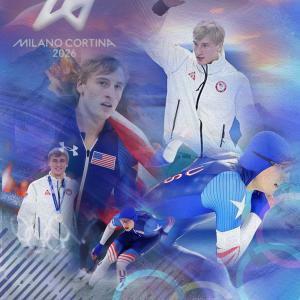
The artistic representation layers crimson and sapphire tones — red symbolizing disciplined intensity, blue reflecting compositional clarity. White podium jackets signal structural control. Silver medal luminosity embodies reflective precision — not absence of gold, but proximity measured in decimals.
The Olympic rings beneath the composition echo ice dance scoring layers: TES, PCS, GOE, placement points, cumulative total. The “26” emblem situates their achievement in Olympic chronology.
Psychological and Structural Impact
Ice dance demands partnership equilibrium. Unlike singles, execution responsibility is shared. Lift stability depends on trust; step sequence synchronization requires identical blade pressure and tempo. Chock and Bates’ 2011 partnership foundation enabled micro-adjustments invisible to spectators yet decisive in scoring.
At Milano Cortina 2026, they achieved dual structural outcomes:
• Olympic Team Gold (19 placement points contribution)
• Olympic Individual Silver (224.39 total score)
Few Olympic athletes secure both team and individual podiums in a single Games cycle. Their Milano Cortina campaign therefore represents layered Olympic permanence.
Conclusion
On 6–7 February 2026, within the controlled physics of Olympic ice, Madison Chock and Evan Bates translated rotational symmetry, lift legality, and compositional depth into definitive numbers:
89.72
133.23
134.67
224.39
19 placement points
1.43-point margin
The blades carved arcs.
The judges computed decimals.
The placement totals accumulated.
And through synchronized vectors of edge and rhythm, Chock and Bates inscribed their legacy into the measured architecture of Milano Cortina 2026.
Add your review
Your email address will not be published. Required fields are marked *
Please login to write review!
Looks like there are no reviews yet.