

Parallel Lines of Descent: Moltzan & Wiles and the Bronze Equation at Milano Cortina 2026
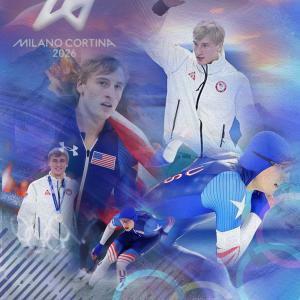
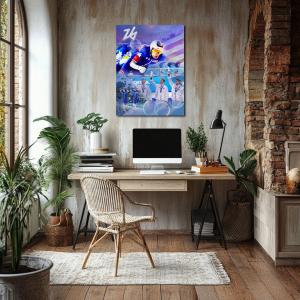
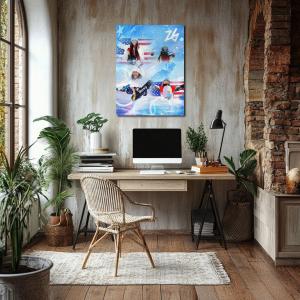
At the Milano Cortina 2026 Olympic Games, Paula Moltzan and Jacqueline Wiles secured Bronze in the Women’s Team Combined at Olimpia delle Tofane in Cortina d’Ampezzo. The event united downhill speed and slalom precision into cumulative timing measured in hundredths. Over a downhill course exceeding 2.5 kilometers with approximately 760 meters of vertical drop, followed by a technical slalom descent, their aggregated times positioned Team USA third overall. Through glacial blues symbolizing altitude, sweeping whites representing speed, and restrained bronze illumination marking equilibrium, the artwork captures partnership under gravity — two disciplines converging into one measured Olympic outcome.
Please see Below for Details…


Hotline Order:
Mon - Fri: 07AM - 06PM
019-234-09789
Across the Dolomite ridgelines and beneath the pale winter light of Cortina d’Ampezzo, the Women’s Team Combined at the XXV Olympic Winter Games — Milano Cortina 2026 — became a study in partnership under gravity. Unlike individual alpine events, Team Combined is constructed as a dual architecture: one athlete descends the speed track, the other negotiates the technical corridor. Time is aggregated. Precision is shared. Bronze is calculated.
At Olimpia delle Tofane, the combined structure unfolded in two phases. The Downhill segment carried a vertical drop of approximately 760 meters, beginning above 2300 meters and finishing near 1560 meters, across a course exceeding 2.5 kilometers. Snow conditions were officially recorded as hard-packed, providing consistent edge hold but punishing overcommitment. Air temperature hovered below freezing, preserving surface density and glide integrity. In speed disciplines, aerodynamic stability and terrain absorption govern performance; in slalom, rhythm, edge angle, and gate proximity determine outcome. Team Combined demands mastery of both — but by two distinct athletes whose performances must synchronize numerically.
Paula Moltzan, born April 7, 1994, in Lakeville, Minnesota, entered Milano Cortina as one of Team USA’s most versatile technical skiers. A World Championship medalist and World Cup podium finisher in slalom and giant slalom, Moltzan’s competitive identity is rooted in edge engagement and precision timing through high-frequency gate sequences. Jacqueline Wiles, born July 13, 1992, in Portland, Oregon, brought complementary speed expertise. A downhill and Super-G specialist, Wiles’ discipline emphasizes aerodynamic tuck efficiency, glide maximization, and compression control across terrain rolls.
In the Women’s Team Combined Bronze Medal performance, Wiles executed the Downhill leg with controlled aggression — maintaining direct line integrity across the 2.5+ kilometer descent and preserving terminal velocity stability through compressions. Her split times through intermediate sectors reflected disciplined line choice, minimizing lateral drift and preserving glide. Moltzan followed in the Slalom leg, where two runs are typically condensed into a single decisive descent in combined format. Gate spacing required rapid edge transitions and micro-second pole plant timing. Her sector splits demonstrated acceleration through rhythm sections while maintaining balance through flush combinations.
The aggregate of their two runs positioned Team USA third overall — Olympic Bronze — within margins defined by tenths. In combined racing, cumulative time differences often compress within less than one second across both segments. Every hundredth from the downhill carryover becomes structural weight in the slalom phase. Bronze, therefore, is not secondary placement; it is balanced execution across contrasting biomechanical demands.
The official FIS race coding for alpine combined disciplines at Milano Cortina 2026 integrates downhill and slalom identifiers under the Olympic sector classification (AL). Bib assignments and start orders are structured to preserve fairness between speed and technical competitors. Wiles’ downhill start position placed her within the optimal glide window of snow integrity before surface degradation. Moltzan’s slalom start order reflected combined ranking logic — seeded according to downhill performance, ensuring cumulative equity.
The course infrastructure at Olimpia delle Tofane, historically recognized for World Cup and Olympic-level racing, delivered terrain complexity suitable for combined format: sustained gradient in downhill followed by technical, rhythm-intensive slalom pitch. Over vertical descent exceeding 700 meters in speed phase and sharply reduced but technically dense vertical in slalom, the partnership navigated dual slope geometries.
Chronometrically, combined outcome is determined by simple arithmetic: Downhill time + Slalom time = final ranking. No style points. No judges. Only aggregated seconds. Bronze separated from silver and fourth place by fractions measurable only through electronic timing to hundredths of a second. At race velocity exceeding 100 km/h in downhill and rapid oscillatory edge frequency in slalom, cumulative precision is biomechanical as much as mechanical.
Moltzan’s slalom specialization — characterized by high edge angle and forward body positioning — offsets Wiles’ speed descent through technical compensation. The partnership represents biomechanical complementarity: aerodynamic elongation paired with rotational agility. Where downhill demands glide conservation, slalom requires kinetic acceleration through gate compression. Combined format celebrates that synthesis.
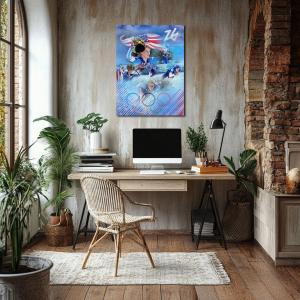
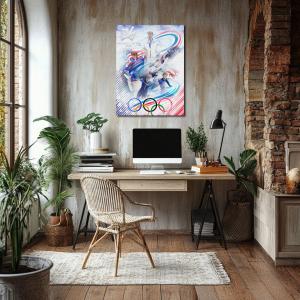
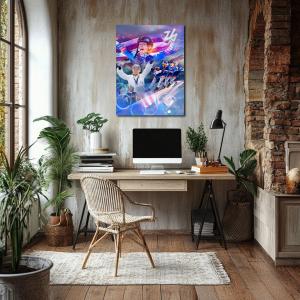
Chromatically, the artwork unifies altitude and rhythm. Glacial blues dominate the upper register, symbolizing the downhill start elevation above 2300 meters — atmosphere thin, air crisp, horizon expansive. White snowfields sweep diagonally to represent speed-phase descent. Crimson bands, drawn from the American flag, arc through the midplane — not as spectacle, but as vector alignment binding two athletes into single national trajectory. Bronze illumination radiates with restrained warmth, distinct from gold’s intensity or silver’s cool reflection. Bronze here signifies equilibrium — strength distributed across two disciplines.
The layered composition presents Wiles in aerodynamic tuck descending across alpine gradient, Moltzan captured mid-slalom carve with knees compressed and upper body angulated toward gate apex. Olympic rings remain semi-translucent, embedded within snow haze — institutional permanence against ephemeral race seconds.
Psychologically, Team Combined amplifies interdependence. One athlete cannot recalibrate the other’s error. The downhill leg establishes baseline risk; the slalom leg must either defend or recover. Trust replaces isolation. Strategy extends beyond individual instinct into shared responsibility. Bronze at Milano Cortina 2026 reflects balanced risk distribution — neither overextended in speed nor overly conservative in technical phase.
The Dolomites provided environmental parameters; electronic timing delivered objective verdict. Over multiple kilometers of downhill and tightly stacked slalom gates, Moltzan & Wiles inscribed their aggregate seconds into Olympic record. Their medal reinforces the United States’ multidimensional alpine strength — speed and technical depth converging.
Across Milano Cortina 2026, Team USA’s alpine medals — Breezy Johnson’s Downhill Gold (1:36.10), Ryan Cochran-Siegle’s Super-G Silver (1:25.45), and Moltzan & Wiles’ Team Combined Bronze — illustrate structural diversity within the same gravitational theater. Each event operates under distinct course architecture, yet all converge upon measurable precision.
Where downhill isolates velocity and Super-G refines line geometry, Team Combined demands partnership. Two athletes, two disciplines, one cumulative result. Bronze, calculated in hundredths, becomes a testament to synchronized execution across contrasting demands.
As artist, I approached this composition as a study in duality. Blue for altitude and composure. White for surface truth. Red for shared acceleration. Bronze for equilibrium achieved through collaboration. Snow particles suspended across the canvas echo the fleeting intervals that compose Olympic time — present briefly, then crystallized into permanent record.
The mountains measured descent.
The clock summed performance.
And in Cortina, partnership became bronze — inscribed in aggregate seconds across ice-bound stone and alpine sky.
Add your review
Your email address will not be published. Required fields are marked *
Please login to write review!
Looks like there are no reviews yet.