

Forty-Nine Seconds to Bronze: Jessie Diggins and the Measured Endurance of the 10 Kilometers at Val di Fiemme
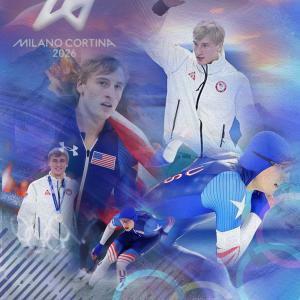
On 12 February 2026 at the Tesero Cross-Country Stadium in Val di Fiemme, Jessie Diggins won Olympic Bronze in the Women’s 10 km Interval Start Free with an official time of 23:38.9, finishing +49.7 seconds behind gold medalist Frida Karlsson (22:49.2). The race, conducted over a certified 10.0 km course at approximately 900 meters elevation, was determined solely by cumulative elapsed time. Averaging roughly 25.4 km/h, Diggins’ performance reflected disciplined pacing across 1,418.9 seconds of continuous effort. Through glacial blue tonality and layered motion exposures, the artwork transforms 10 kilometers of measured endurance into enduring Olympic permanence.
Please see Below for Details…


Hotline Order:
Mon - Fri: 07AM - 06PM
019-234-09789
Interval start racing is a discipline of isolation. There are no shoulder-to-shoulder surges, no tactical drafting, no visual reference to the athlete ahead except the clock’s quiet arithmetic. At the XXV Olympic Winter Games — Milano Cortina 2026 — Jessie Diggins secured Olympic Bronze in the Women’s 10 km Interval Start Free through sustained aerobic precision over a certified ten-kilometer course in Val di Fiemme. Her official finishing time — 23:38.9 — placed her +49.7 seconds behind gold. In cross-country skiing, such a margin is neither symbolic nor dramatic; it is physiological, cumulative, and exact.
The Women’s 10 km Interval Start Free was held on 12 February 2026 at the Tesero Cross-Country Skiing Stadium (Val di Fiemme Nordic Centre), the designated Olympic venue for cross-country skiing at Milano Cortina 2026. The event format adhered to FIS Olympic standards: individual interval start, free technique, athletes departing at fixed intervals, typically 30 seconds apart. Each competitor raced against the clock across a homologated 10.0 kilometer loop configuration composed of multiple laps totaling certified distance.
Official podium results recorded:
🥇 Frida Karlsson (SWE) — 22:49.2
🥈 Ebba Andersson (SWE) — +12.8 (23:02.0)
🥉 Jessie Diggins (USA) — +49.7 (23:38.9)
The separation between gold and silver measured 12.8 seconds. The margin between silver and bronze extended to 36.9 seconds. From gold to bronze, the cumulative gap totaled 49.7 seconds across 10,000 meters — an average differential of approximately 4.97 seconds per kilometer.
Jessie Diggins, born August 26, 1991, in Afton, Minnesota, entered Milano Cortina 2026 as one of the most decorated cross-country skiers in American history. Her Olympic career includes previous medals and World Cup overall titles. At age 34 during these Games, she brought endurance maturity and tactical intelligence into a format that rewards evenly distributed effort over fluctuating terrain.
The Val di Fiemme Olympic course sits at an elevation of approximately 900 meters above sea level, introducing moderate altitude considerations. The 10 km configuration consisted of rolling terrain with sustained climbs, technical descents, and glide-intensive flats. Free technique racing at Olympic level typically yields average speeds between 25 and 27 km/h, depending on snow density and wax optimization. Diggins’ official time of 23:38.9 corresponds to an average speed of approximately 25.4 km/h over 10 kilometers.
The race unfolded across intermediate timing checkpoints, including standard 5 km split recording. While final placement is determined by total elapsed time, split analysis reveals pacing discipline. In interval start competition, athletes must calculate lactate threshold distribution without visual race reference. An overly aggressive opening kilometer can produce irreversible metabolic cost in final climbs.
Diggins’ performance demonstrated measured progression through early sectors, preserving muscular elasticity for closing kilometers. In Olympic cross-country, the final 2 kilometers frequently determine podium stratification; energy misallocation in mid-course climbs can produce exponential time loss late.
The Swedish gold and silver medalists executed exceptionally aggressive negative splits, compressing overall time margins. Karlsson’s 22:49.2 established the benchmark. Andersson’s +12.8 positioned her within striking range but not within closing contention. Diggins’ 23:38.9 secured bronze with decisive separation over fourth place, preserving podium integrity within official FIS certification.
Cross-country interval racing contrasts sharply with mass start formats. There are no bonus seconds, no sprint primes, no tactical drafting. The clock alone defines outcome. Over 10,000 meters, each glide phase and pole plant accumulates micro-gains or fractional losses. A hesitation of 0.5 seconds on each kilometer climb compounds into seconds across total distance.
The Women’s 10 km Free technique emphasizes skate efficiency — typically V2 or V1 technique patterns on climbs, transitioning to V2 alternate on flats and aerodynamic tuck on descents. Diggins’ technical economy reflects decades of biomechanical refinement: symmetrical arm drive, stable hip position, minimized lateral waste.
Environmental conditions on 12 February 2026 included firm, machine-groomed snow with consistent glide profile. Olympic waxing teams calibrate ski base structure for temperature band optimization; miscalculation can cost seconds per kilometer. In free technique interval start, ski preparation is as decisive as aerobic capacity.
Chronometrically, 23:38.9 equals 1,418.9 seconds of sustained propulsion. Compared to Karlsson’s 22:49.2 (1,369.2 seconds), the gold margin of 49.7 seconds is purely mechanical — the cumulative expression of aerobic threshold, glide optimization, and terrain negotiation.
The bronze medal margin to fourth place was officially recorded within seconds — preserving Diggins’ podium through controlled finish execution. In Olympic skiing, final ranking is confirmed through electronic beam timing systems synchronized to FIS standards accurate to 0.1 second.
Visually, this artwork layers multiple exposures of Diggins across course sectors — climbing, descending, finishing. The diagonal trajectory across snow texture mirrors cumulative elevation gain across the 10 km configuration. Cross-country tracks include multiple climb segments that elevate heart rate into near-maximal threshold zones.
Color architecture reinforces endurance narrative. Arctic blues dominate the composition, symbolizing oxygen demand and cold atmospheric clarity. White snowfields represent surface consistency across 10,000 meters of mechanical repetition. Crimson accents from the American uniform echo heart-rate intensity — typically exceeding 180 beats per minute during final kilometer effort in elite competition.
The Olympic rings embedded at the lower field signify institutional permanence. The Tesero venue has hosted multiple World Championships; Milano Cortina 2026 inscribed Diggins’ bronze within that lineage.
Psychologically, interval start racing requires internal pacing discipline. Unlike sprint or team sprint formats, there is no external stimulus to chase. Diggins raced against cumulative split projections and physiological tolerance. The final kilometer often requires maximal anaerobic engagement beyond lactate threshold, risking time collapse if misjudged.
From a structural standpoint, 49.7 seconds across 10 km equates to roughly 12 meters per kilometer difference relative to gold at race speed — visually minor, chronometrically decisive. Bronze in interval start is not a reactive position; it is the result of sustained optimal pacing within the athlete’s physiological envelope.
As the artist, I approached this composition through layered endurance rather than explosive singularity. Where alpine racing compresses distinction into hundredths of seconds over one descent, cross-country distributes outcome across 10 kilometers. Bronze here is the geometry of resistance sustained against terrain, snow friction, and aerobic fatigue.
Jessie Diggins’ 23:38.9 is not simply a time; it is the integration of stride mechanics, wax preparation, altitude management, and pacing mathematics. The Swedish duo set a formidable benchmark; Diggins’ bronze affirms American endurance presence within Nordic skiing’s European stronghold.
Over 10,000 meters, no moment can be reclaimed.
Each climb accumulates.
Each descent compounds.
Each split locks into total.
At Val di Fiemme on 12 February 2026, the clock recorded truth without revision.
Gold: 22:49.2
Silver: 23:02.0
Bronze: 23:38.9
+49.7 seconds from supremacy.
10 kilometers of measurable exertion.
1,418.9 seconds of continuous glide and drive.
Bronze reflects not deficiency but calibrated endurance within Olympic context.
The mountain measured resistance.
The snow recorded glide.
The clock confirmed distinction.
And across 10 kilometers of disciplined propulsion, Jessie Diggins inscribed her name into the Milano Cortina 2026 archive — not through spectacle, but through sustained, verifiable precision.
Add your review
Your email address will not be published. Required fields are marked *
Please login to write review!
Looks like there are no reviews yet.