
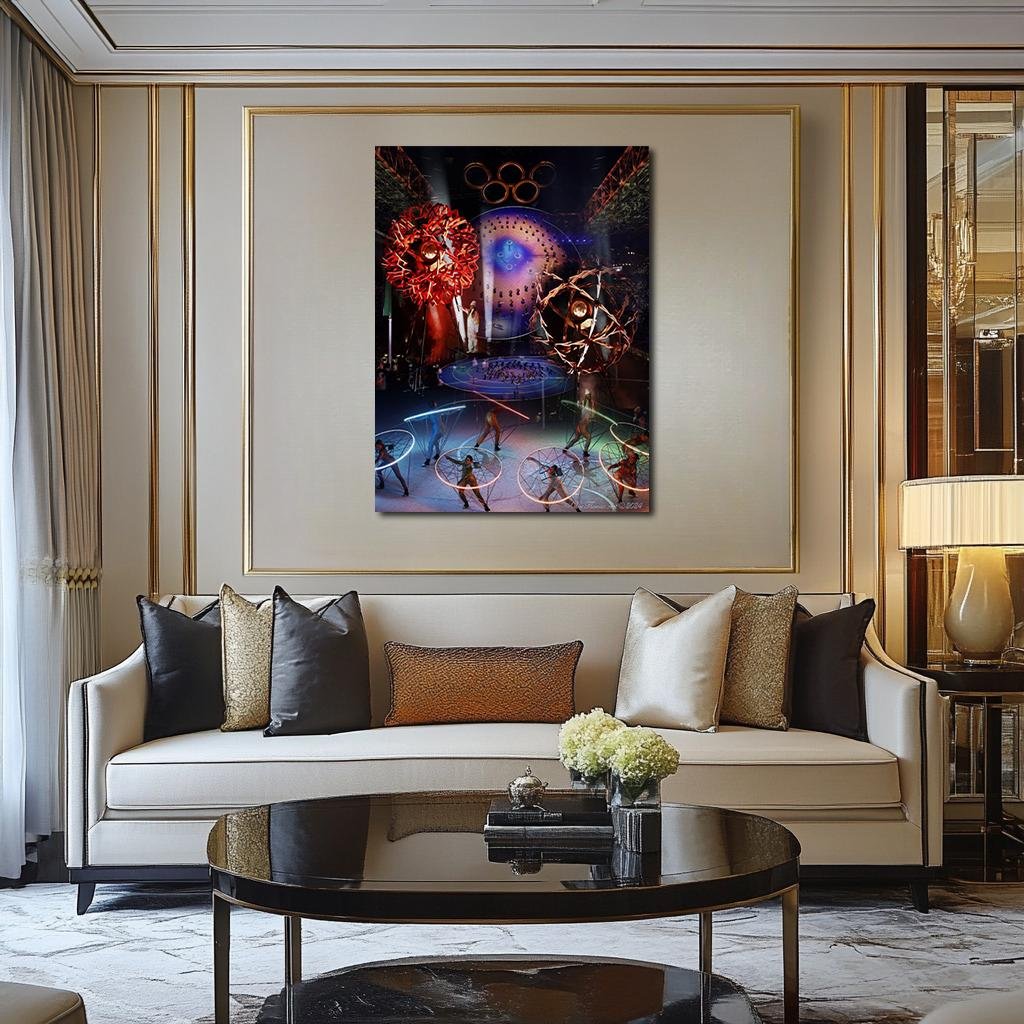

Orbital Flames: When Light Engineered Harmony Beneath the Olympic Sky
Stadium on 6 February 2026, this artwork transforms technological spectacle into a meditation on unity and innovation. Towering kinetic spheres glow with red and bronze intensity, symbolizing passion guided by discipline, while dancers trace luminous orbits that echo the Olympic rings above. Midnight blues convey trust and global cooperation, balanced by warm ambers that reflect human connection. Rising visually from choreographed motion toward celestial symbolism, the composition embodies “Armonia” — the harmonious convergence of science, culture, and athletic ambition — reminding us that the Olympics illuminate not only competition, but humanity’s collective forward path.
Please see Below for Details…


Hotline Order:
Mon - Fri: 07AM - 06PM
404-872-4663
This artwork captures a technologically radiant and symbolically layered moment inspired by the Opening Ceremony of the XXV Olympic Winter Games — Milano Cortina 2026, held on 6 February 2026 inside the monumental San Siro Stadium (Stadio Giuseppe Meazza) in Milan, Italy, where the ceremony officially began at approximately 20:00 Central European Time and unfolded across nearly three and a half hours of artistic performance, protocol, and global broadcast. Conceived under the philosophical theme “Armonia” — Harmony, the ceremony sought to unite human creativity with scientific innovation, echoing Italy’s legacy as a birthplace of both artistic mastery and technological imagination. This composition transforms that real-world spectacle into a luminous orchestration of motion, geometry, and fire — where every visual element appears engineered yet deeply emotional.
At the highest visual plane hover the unmistakable Olympic rings, suspended like celestial architecture against a midnight atmosphere. Their golden illumination is restrained yet authoritative, symbolizing excellence, endurance, and continuity across generations. Positioned above the unfolding choreography, the rings function as a gravitational center — reminding viewers that every performance ultimately orbits the ideals of the Olympic Charter: friendship, respect, and peaceful competition. Gold here conveys permanence rather than opulence; it is the glow of legacy.
Just below this symbolic firmament emerges a vast circular stage, echoing planetary geometry. The circular form is particularly meaningful — it represents unity without hierarchy, a world gathered without edges. This spatial design mirrors the ceremony’s intent to bring together not only nations but landscapes, linking Milan’s metropolitan energy with the alpine venues of Cortina d’Ampezzo, Livigno, and Predazzo in a historically distributed Olympic format.
Dominating the upper left is a monumental red kinetic structure — a complex sphere composed of interlocking angular fragments. Its fiery hue immediately commands attention. Red, in Olympic symbolism, is vitality itself: the pulse beneath every athlete’s preparation, the courage required to step into global visibility. Yet the structure also evokes Italian futurism — a movement that celebrated speed, machinery, and modern life. Its fragmented geometry suggests motion frozen in time, as though capturing the instant of ignition.
Opposite it rises a darker metallic orb, bronze and ember-lit, resembling a mechanical sun. Where the red sphere expresses explosive energy, this darker structure suggests controlled combustion — discipline guiding power. The pairing of these two monumental forms introduces a subtle dialogue: passion balanced by precision. Together they echo the equilibrium required in elite sport, where emotional intensity must be governed by technical mastery.
Between these structures stretches a luminous circular field populated by performers arranged in disciplined formations. Seen from above, they resemble constellations — human stars mapped onto a terrestrial galaxy. Their placement reflects architectural thinking common in Italian stagecraft, where geometry organizes narrative. The performers’ dark attire contrasts with the glowing floor, emphasizing humanity against the vastness of space.
At the lower register, dancers manipulate illuminated hoops that radiate cool white and electric blue. These rings mirror the Olympic symbol above, creating a visual recursion — small orbits reflecting larger ones. Blue historically represents trust, diplomacy, and global cooperation; its prominence here reinforces the international spirit of the Games. The glowing hoops also evoke technological elegance, recalling Milano Cortina’s emphasis on sustainable lighting systems and forward-looking infrastructure.
The performers’ movements appear synchronized yet fluid, illustrating the balance between discipline and freedom. Light trails follow their arcs, transforming choreography into temporary calligraphy written across the stadium floor.
Color interpretation becomes essential to understanding the artwork’s emotional architecture. The deep midnight blue background stabilizes the composition, offering psychological calm amid dynamic motion. Blue is the color of reliability — the quiet promise that competition occurs within shared rules. Amber highlights scattered across the stage introduce warmth, suggesting human connection beneath technological brilliance. Subtle magentas and violets emerge near the central platform, representing creativity and transformation — qualities intrinsic not only to art but to athletic evolution.
Light itself becomes structural. Vertical beams descend from above like invisible pillars, recalling cathedral architecture — a fitting metaphor in a country where geometry and spirituality historically converged. Olympic ceremonies often function as secular rituals, and these luminous columns reinforce that sacred undertone.
If one reads the composition vertically, a narrative unfolds with elegant clarity: dancers → geometric stage → kinetic spheres → Olympic rings → infinite sky. Humanity rises through invention toward idealism. Motion becomes memory; memory becomes history.
Emotionally, the artwork radiates controlled grandeur rather than sensory excess. Critics often noted the ceremony’s refined balance — spectacular yet disciplined — and this composition embodies that equilibrium. There is dynamism, yet also breathing room; innovation, yet reverence for tradition.
Time itself is quietly embedded in the scene. Though this spectacle belongs to a precise winter evening in early February 2026, the imagery suggests permanence. Olympic ceremonies exist in paradox — fleeting performances that echo across decades.
Notably, the Milano Cortina Opening Ceremony also represented logistical innovation. By integrating multiple geographic clusters, the Games demonstrated a modern approach to hosting — reducing travel strain for athletes competing in mountain events while symbolically bridging urban and alpine identities. That spirit of connection resonates throughout the artwork’s orbital motifs.
The emotional temperature of the scene leans toward awe. The towering spheres feel almost astronomical, inviting viewers to contemplate humanity’s place within something larger. Technology here does not overshadow humanity; it amplifies it.
Ultimately, the composition succeeds because nothing exists in isolation. Geometry belongs to science. Fire belongs to ritual beginnings. Light belongs to hope. Motion belongs to time.
This is harmony — not uniformity, but resonance.
Exactly the philosophical center envisioned for Milano Cortina 2026, where artistry, engineering, and athletic aspiration aligned beneath a shared winter sky, reminding the world that progress and tradition are not opposites, but partners in the choreography of civilization.
Add your review
Your email address will not be published. Required fields are marked *
Please login to write review!
Looks like there are no reviews yet.

Spiral of Awakening: When Light, Flight, and Water Composed the Milan Invocation
$44,490.00 $44,490.00
Choreography of Eternity: When Motion Became Memory Beneath the Milan Constellation
$44,500.00 $44,500.00
Chromatic Aria — When Color Learned to Sing Beneath the Winter Sky
$44,700.00 $44,700.00